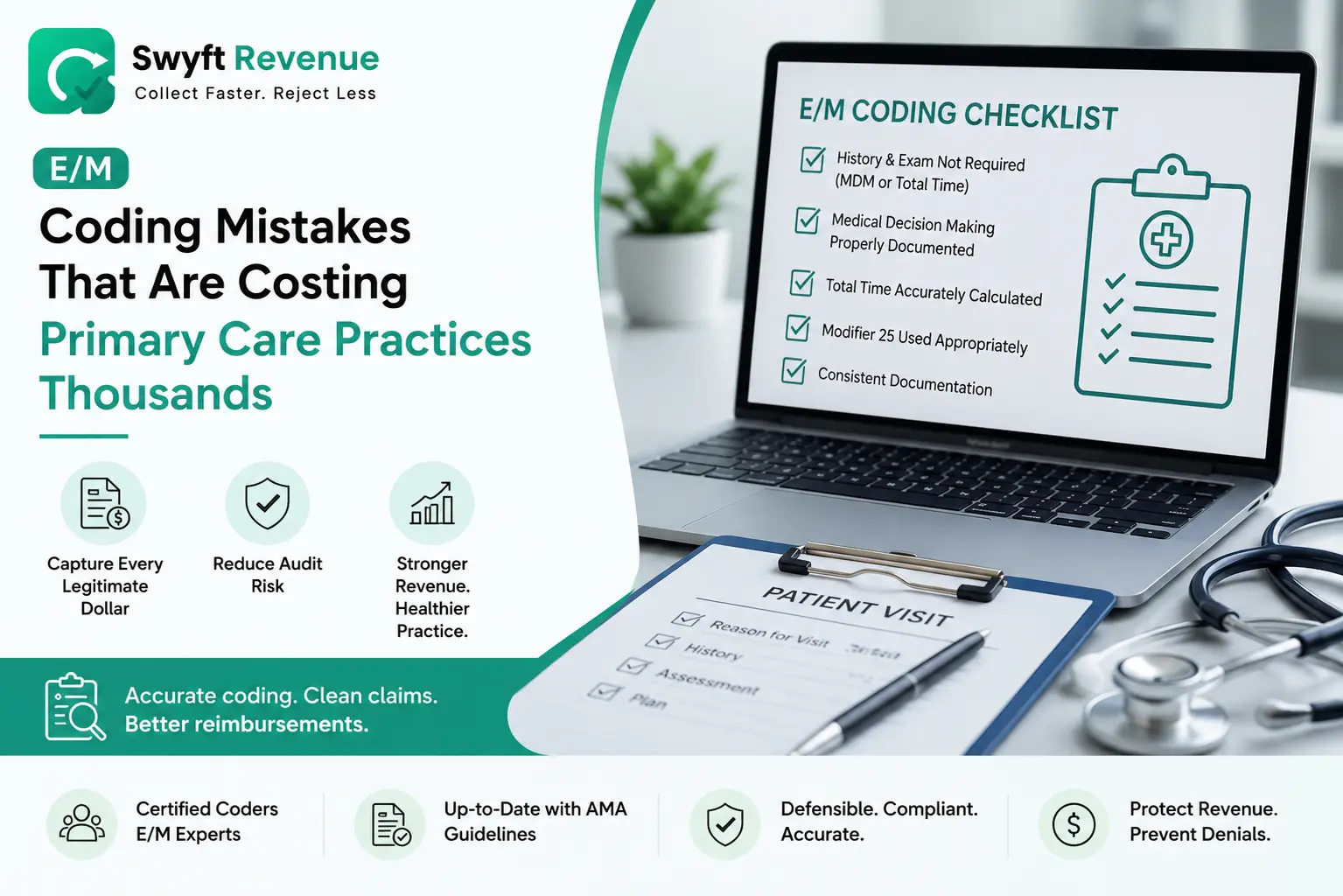
E/M Coding Mistakes That Are Costing Primary Care Practices Thousands
Aug 21, 2026
Evaluation & Management (E/M) coding is the backbone of primary care billing nearly every patient visit runs through it....
Read More →
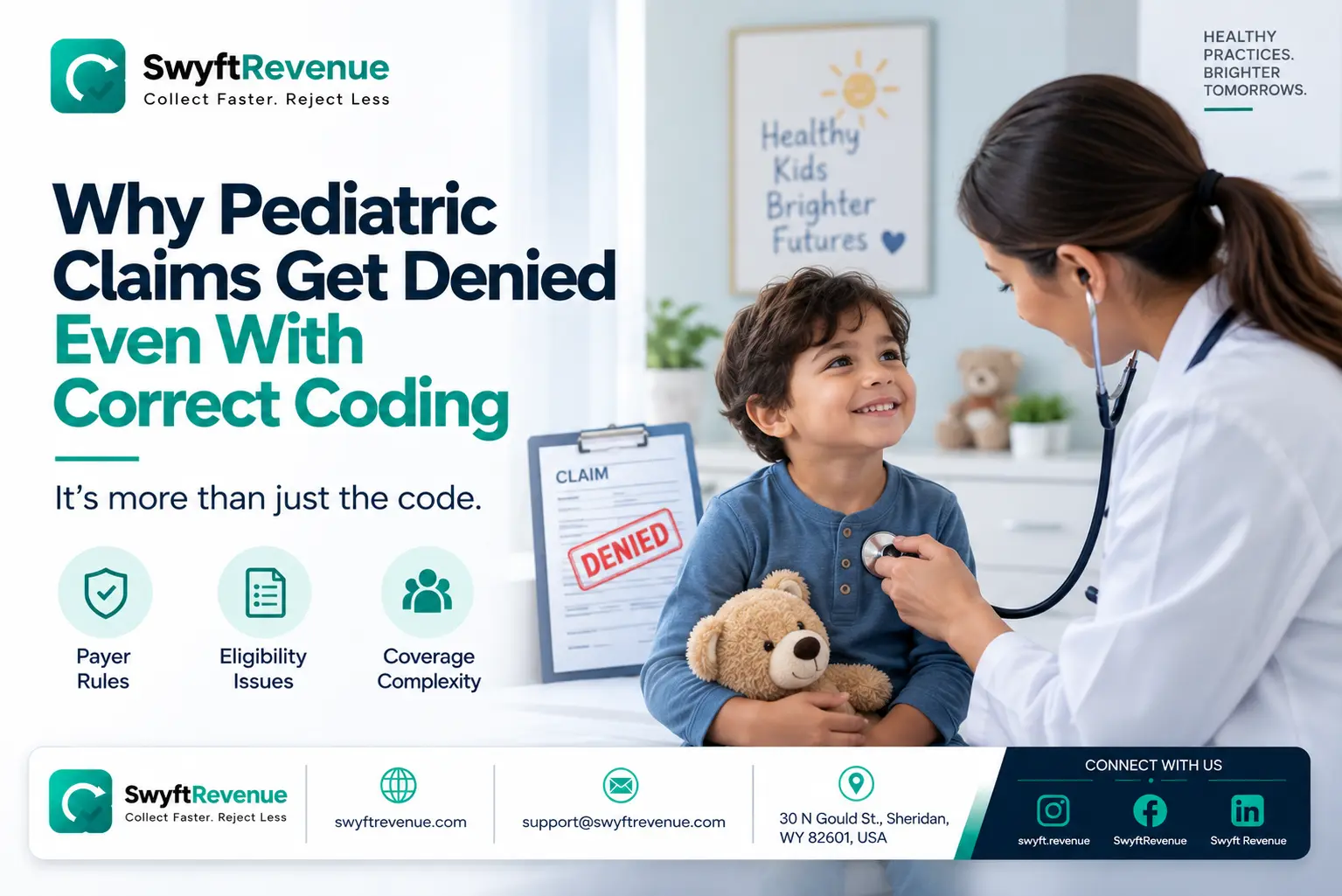
A pediatric claim can be coded correctly and still come back unpaid. The diagnosis may be accurate, the procedure codes appropriate, and the documentation complete, yet the payer can still reject or deny the claim.
The reason is simple: correct coding is only one part of pediatric medical billing.
Pediatric practices handle preventive visits, immunizations, vaccine administration, Medicaid and CHIP coverage, and services connected with EPSDT. Each can introduce payer-specific requirements that affect reimbursement.
Understanding why pediatric claims get denied therefore requires looking beyond the code. Eligibility, documentation, claim combinations, payer rules, authorization, and follow up can all influence whether a claim becomes revenue.
1. Correct Coding Does Not Guarantee Payment
Choosing the correct CPT and ICD-10 codes does not automatically mean a claim will be paid. Payers evaluate services, diagnosis, patient information, coverage, provider details, modifiers, documentation, and payer specific requirements.
A claim can contain technically correct codes and still fail because the overall submission does not satisfy a payer rule. Effective pediatric revenue cycle management therefore has to extend beyond code selection and continue after submission.
2. Well Child Visits Can Create Billing Complications
Pediatric practices often provide several services during one appointment. A child may arrive for a well child visit and receive vaccines, vaccine counseling, or other preventive services during the same encounter.
Clinically, this is efficient. From a billing perspective, the services may interact differently depending on payer requirements.
This is where well child visit billing rules matter. Practices need to consider whether services are separately reportable, how the payer treats the encounter, and whether the claim reflects the services actually provided.
A claim can contain appropriate codes but still be denied, bundled, or paid differently because of how the services are evaluated together.
3. Vaccine Administration Billing Issues
Immunizations are a major part of pediatric care, but they can also create recurring reimbursement challenges. There is a distinction between reporting the vaccine product and reporting its administration. Multiple vaccines can make administration reporting and payer rules more complicated.
Important areas include vaccine product billing, administration, patient age, counseling, documentation, and payer specific reimbursement policies.
These vaccine administration billing issues can affect otherwise routine claims.
4. Medicaid and CHIP Add Another Layer
Pediatric practices frequently serve children covered by Medicaid or CHIP, the Children's Health Insurance Program. Their requirements can differ from commercial insurance.
Pediatric Medicaid and CHIP billing may involve different coverage rules, managed care arrangements, eligibility requirements, authorization processes, and state specific considerations.
A workflow that works for a commercial payer may not work the same way for a Medicaid plan. A service can be medically appropriate and correctly coded while the claim still encounters a coverage or processing issue.
5. EPSDT Requirements Can Affect Claims
EPSDT stands for Early and Periodic Screening, Diagnostic, and Treatment. It is a Medicaid program focused on comprehensive healthcare services for eligible children.
Because pediatric practices may provide preventive screenings and medically necessary services within this environment, EPSDT billing requirements can become relevant to the revenue cycle.
Practices must ensure that applicable services, documentation, diagnosis information, coverage, and payer requirements align with the claim. When these elements do not, reimbursement can be delayed and A/R can remain unresolved.
6. Eligibility Problems Can Override Correct Coding
Another reason pediatric claim denials occur has nothing to do with the code.
Children's insurance coverage can change. A patient may move between Medicaid, CHIP, commercial insurance, or a managed care plan. Coverage that existed when an appointment was scheduled may not be active on the date of service.
This makes insurance eligibility verification for pediatricians an important part of the billing process.
Potential issues include inactive coverage, incorrect payer information, plan changes, missing authorization, or non-covered services. A coding review cannot replace a complete eligibility check.
Why Pediatric Claim Denials Become Expensive
One denied claim may not seem significant. Repeated denials are different. If the same issue affects dozens of claims every month, the practice is dealing with a revenue cycle pattern rather than isolated billing mistakes.
Recurring pediatric claim denials can contribute to delayed reimbursement, increased accounts receivable, more payer follow up, additional claim corrections, administrative workload, longer payment cycles, and revenue leakage.
The financial effect can be especially meaningful when small problems repeat across a high-volume pediatric practice. The goal should not simply be to correct individual claims after they fail. Practices also need visibility into patterns affecting their overall revenue cycle.
How Swyft Revenue Supports Pediatric Practices
Swyft Revenue provides pediatric billing services that support the revenue cycle beyond claim submission. Our support includes medical billing and coding, insurance eligibility verification for pediatricians, clean claim submission, pediatric denial management, pediatric A/R recovery, patient collections, and revenue cycle reporting.
Why Outsourced Pediatric Billing Can Help
As patient volume and payer complexity grow, internal teams can face more claims, eligibility checks, denials, follow up, and A/R work. Outsourced pediatric billing gives practices dedicated billing support without managing every revenue cycle function internally.
Who We Serve
Swyft Revenue provides specialized billing and RCM support for Pediatrics, Cardiology, Orthopedics, Dermatology, Behavioral Health, Gastroenterology, Neurology, Pain Management, Podiatry, and Ophthalmology.
Areas We Cover
Swyft Revenue provides medical billing and revenue cycle management services across all 50 U.S. states, including California, Texas, Florida, New York, Pennsylvania, Illinois, Ohio, Georgia, North Carolina, Michigan, New Jersey, Virginia, Washington, Arizona, Massachusetts, Tennessee, Indiana, Missouri, Maryland, Wisconsin, Colorado, Minnesota, South Carolina, Alabama, Louisiana, Kentucky, Oregon, Oklahoma, Connecticut, Utah, Iowa, Nevada, Arkansas, Mississippi, Kansas, New Mexico, Nebraska, West Virginia, Idaho, Hawaii, New Hampshire, Maine, Montana, Rhode Island, Delaware, South Dakota, North Dakota, Alaska, Vermont, and Wyoming, as well as Washington, D.C. Contact us to confirm service availability for your practice.
FAQs
Why do pediatric claims get denied if the coding is correct?
Correct coding is only one part of claim processing. Eligibility, payer policies, documentation, authorization, service combinations, and other requirements can affect reimbursement.
What are common pediatric billing problems?
Issues can involve well child visits, vaccine administration, Medicaid and CHIP requirements, EPSDT-related services, eligibility, denials, and unpaid A/R.
Why are Medicaid and CHIP important in pediatric billing?
Their requirements can differ from commercial insurance, so pediatric practices need payer-specific billing workflows.
Can vaccine administration cause billing issues?
Yes. Vaccine product and administration billing can involve different reporting and reimbursement considerations.
What is EPSDT in pediatric billing?
EPSDT means Early and Periodic Screening, Diagnostic, and Treatment. It is a Medicaid program for eligible children, and applicable requirements can affect pediatric services and claims.
How to Book Our Service
Getting started with Swyft Revenue is simple:
1. Contact Us — Tell us about your practice and billing setup.
2. Discuss Your Challenges — Share your denial, A/R, eligibility, or workload concerns.
3. Request a Healthcare Revenue Audit — A healthcare revenue audit for pediatric clinics can identify areas where revenue may be delayed or unresolved.
4. Review Your Options — We discuss the right RCM support for your practice.
5. Get Dedicated Billing Support — Swyft Revenue supports the ongoing revenue cycle.
Why Practices Choose Swyft Revenue
Pediatric practices already have demanding clinical and administrative responsibilities. Swyft Revenue helps reduce billing pressure with medical billing, eligibility verification, clean claims, pediatric denial management, pediatric A/R recovery, patient collections, and revenue cycle reporting.
Our focus is the complete path from patient coverage to claim submission to reimbursement.
Conclusion
A pediatric claim does not become payable simply because the codes are correct. Preventive visits, vaccines, Medicaid, CHIP, EPSDT, eligibility, payer policies, and follow up can all influence whether a claim is paid, delayed, or denied.
If your pediatric practice is spending too much time correcting claims, investigating denials, or following up on unpaid balances, look beyond individual coding errors and examine the broader revenue cycle.
Swyft Revenue can help identify billing challenges, strengthen claim follow up, and keep outstanding revenue moving.
Request Your Free Healthcare Revenue Audit
Email: support@swyftrevenue.com
Contact: https://swyftrevenue.com/contact
Swyft Revenue — Collect Faster. Reject Less.