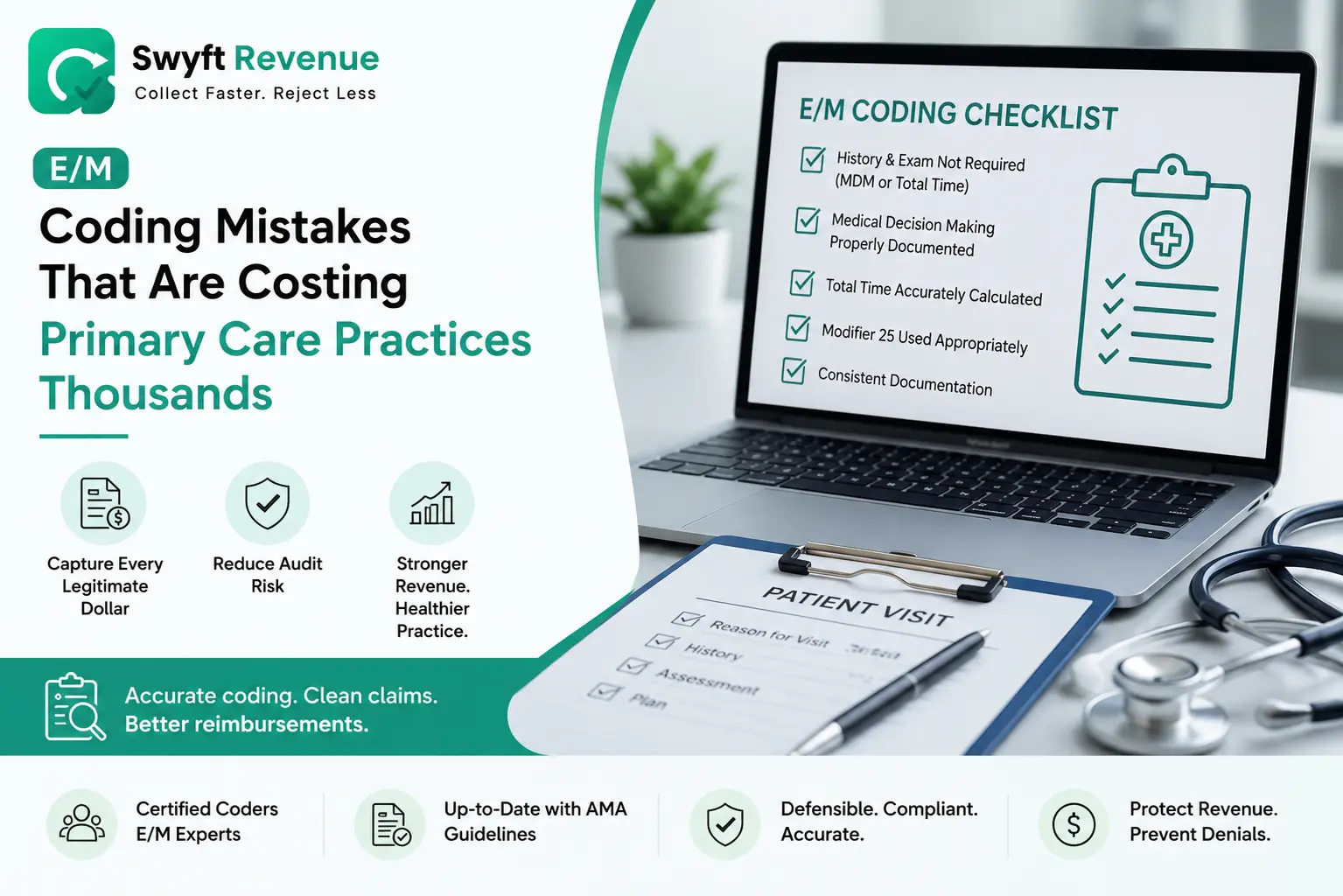
E/M Coding Mistakes That Are Costing Primary Care Practices Thousands
Aug 21, 2026
Evaluation & Management (E/M) coding is the backbone of primary care billing nearly every patient visit runs through it....
Read More →

US dermatology practices see a high volume of patients and perform a wide range of services in a single visit, evaluations, biopsies, lesion removals, and procedures that often happen back to back. That efficiency is good for patient care. It is also one of the biggest reasons dermatology claims get bundled under CMS's National Correct Coding Initiative, reduced, or underpaid, often without the practice fully realizing why.
"Are we actually being reimbursed for everything performed, or is part of it quietly disappearing into a bundled payment?"
1. Modifier 25 Misuse During Combined Visits
Many dermatology visits combine an evaluation and management service with a same day procedure, a mole check that leads to a biopsy, for example. Billing both correctly requires modifier 25 to indicate the E/M service was significant and separately identifiable from the procedure.
Applied inconsistently, or without documentation that clearly supports it, this remains one of the top reasons US payers, including Medicare and commercial carriers, deny or reduce dermatology claims, even when both services were clinically justified.
2. NCCI Bundling on Biopsy and Lesion Destruction
When a biopsy and a lesion removal or destruction happen during the same visit, on the same or adjacent site, CMS's NCCI edits may bundle these procedures into a single, lower payment instead of reimbursing each independently.
Practices unfamiliar with which specific code pairs are subject to these edits can lose reimbursement on visits that involved genuinely distinct clinical work.
3. Cosmetic vs Medically Necessary Classification Disputes
Dermatology sits at the intersection of medical and cosmetic care, and US payers, particularly Medicare and Medicaid, scrutinize this boundary closely. A procedure considered medically necessary in one clinical context can be classified as cosmetic, and therefore excluded from coverage, in another, depending on how the documentation supports the diagnosis.
This gray area drives a meaningful share of denials for services like lesion removal, scar treatment, and select skin condition procedures.
4. Multiple Procedure Payment Reductions
When several procedures happen in one visit, many payers apply automatic reductions to secondary and subsequent procedures under standard multiple surgery payment rules. Practices that don't track whether these reductions are being calculated correctly may be losing more per visit than they realize.
5. Pathology and Lab Billing Separation
Dermatology frequently involves sending specimens out for pathology review, and correctly separating the professional and technical billing components is easy to get wrong. Confusion over what the practice bills versus what an outside lab bills can quietly create missed revenue or duplicate billing.
6. Documentation That Triggers Downcoding
Even a correctly coded visit can be downcoded by a payer if the documentation doesn't fully support the distinct complexity of each service performed, resulting in lower reimbursement than the visit actually warranted.
7. Coding Drift Across High Patient Volume
Because dermatology practices often see a high number of patients daily, coding decisions happen quickly and repeatedly. Without regular review, small inconsistencies can compound across hundreds of monthly claims into a real revenue gap.
Who This Affects Most
This pattern tends to show up most in dermatology practices that:
Specialized Billing Built for How Dermatology Actually Works
Rather than applying generic billing rules, accurate dermatology reimbursement depends on understanding the specific coding relationships, payer edits, and documentation standards that apply to combined E/M and procedure visits, biopsy and destruction pairings, and cosmetic classification decisions.
That includes ongoing attention to:
Why Practices Work With a Dermatology Focused Billing Team
Fewer coding blind spots: Modifier and bundling decisions are reviewed by people who understand dermatology's specific coding relationships, not generic billing rules.
Faster resolution: Denials and underpayment patterns get investigated as they happen, not discovered months later in a year end report.
Documentation guidance: Practices gain clearer insight into what documentation actually supports medical necessity for borderline procedures.
Reporting that shows the real picture: Revenue reporting is built to surface bundling, downcoding, and reduction patterns specifically, not just a general A/R summary.
Support that scales: Billing oversight can expand as patient volume, providers, or procedure mix grows.
Specialties We Support Across the US
Swyft Revenue provides specialty medical billing and revenue cycle management for practices nationwide, including:
Nationwide US Coverage
Swyft Revenue provides medical billing and revenue cycle management services across all 50 U.S. states, including California, Texas, Florida, New York, Pennsylvania, Illinois, Ohio, Georgia, North Carolina, Michigan, New Jersey, Virginia, Washington, Arizona, Massachusetts, Tennessee, Indiana, Missouri, Maryland, Wisconsin, Colorado, Minnesota, South Carolina, Alabama, Louisiana, Kentucky, Oregon, Oklahoma, Connecticut, Utah, Iowa, Nevada, Arkansas, Mississippi, Kansas, New Mexico, Nebraska, West Virginia, Idaho, Hawaii, New Hampshire, Maine, Montana, Rhode Island, Delaware, South Dakota, North Dakota, Alaska, Vermont, and Wyoming, as well as Washington, D.C.
Contact us to confirm service availability for your practice.
Frequently Asked Questions
Why do dermatology claims get bundled under CMS rules?
CMS's National Correct Coding Initiative bundles certain procedure pairs, such as a biopsy and a lesion destruction performed at the same site during one visit, into a single, reduced payment instead of separate reimbursement for each.
What does modifier 25 do in dermatology billing?
It signals to the payer that an E/M service was significant and separately identifiable from a procedure performed the same day. Missing or unsupported use of this modifier is a leading cause of dermatology denials with Medicare and commercial payers alike.
How is cosmetic vs medically necessary determined for dermatology procedures?
US payers evaluate documentation against specific medical necessity criteria. The same procedure can be covered or denied depending entirely on how the clinical justification is documented.
Which specialties does Swyft Revenue support?
Cardiology, orthopedics, dermatology, behavioral health, pediatrics, gastroenterology, neurology, pain management, podiatry, and ophthalmology practices across the US.
How do I find out if my practice is losing revenue to bundling or downcoding?
A revenue audit reviews recent claims and payment patterns to identify where bundling, modifier issues, or downcoding may be reducing reimbursement.
Getting Started
The Bigger Picture
Bundling and underpayment in dermatology billing are rarely one obvious mistake. They're usually a pattern of small, repeated coding and documentation gaps across a high volume of procedure heavy visits, the kind of pattern that's hard to catch without dedicated, specialty specific review.
The real question isn't just how much is in your A/R.
It's whether your current billing process is capturing the full value of the care you're actually providing.
Find Out What Your Dermatology Billing Is Really Producing
Get Your Free Healthcare Revenue Audit → https://swyftrevenue.com/contact