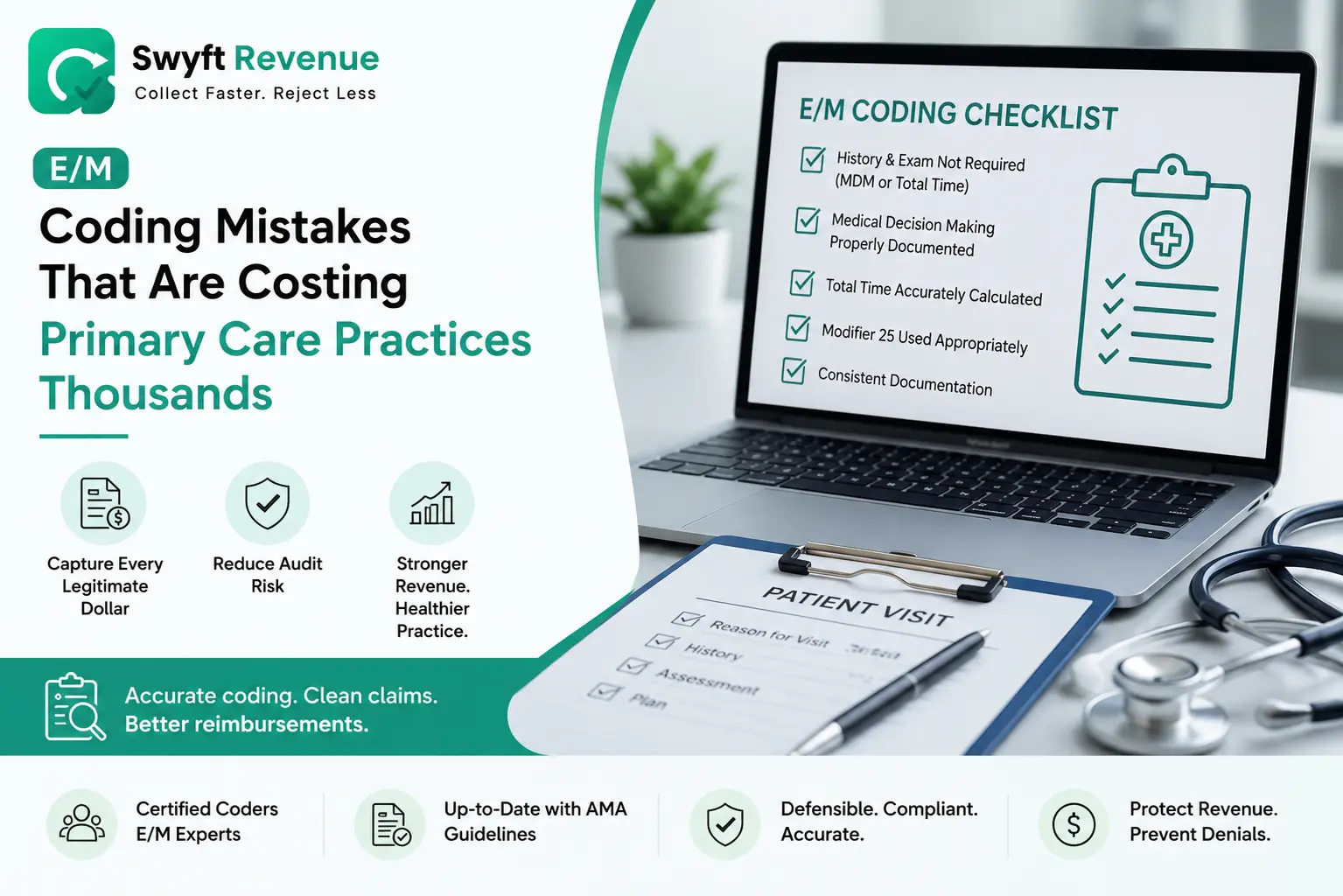
E/M Coding Mistakes That Are Costing Primary Care Practices Thousands
Aug 21, 2026
Evaluation & Management (E/M) coding is the backbone of primary care billing nearly every patient visit runs through it....
Read More →

Running a cardiology practice is already demanding. Between patient care, complex procedures, documentation, payer requirements, and administrative responsibilities, medical billing can quickly become another major source of pressure.
And when cardiology medical billing is not handled properly, the impact is not limited to paperwork.
It can affect claims, accounts receivable, cash flow, and ultimately the revenue your practice collects.
Cardiology is also not a specialty where a generic billing approach always works. Medical billing for cardiologists requires attention to specialty specific coding, documentation, payer requirements, claims, and reimbursement processes.
Here are five cardiology billing problems that may be quietly affecting your practice.
1. Cardiology Claim Denials Keep Increasing
A denied claim is more than an administrative inconvenience.
Every denial creates additional work and can delay payment that your practice was expecting.
For cardiology practices, claims may involve evaluation and management services, diagnostic testing, procedures, and other specialty specific services. When coding, documentation, payer requirements, or claim information do not align, a claim can become difficult to collect.
The bigger concern is cardiology claim denials that happen repeatedly.
If the same types of claims continue coming back unpaid, your practice may be dealing with a revenue cycle problem rather than isolated billing mistakes.
Over time, recurring denials can contribute to:
Effective cardiology denial management is therefore an important part of protecting the revenue your practice has already earned.
Your practice should not have to discover recurring billing problems only after the payment fails to arrive.
2. Aging A/R Keeps Growing
A growing A/R balance can be one of the clearest signs that revenue is getting stuck somewhere in the billing cycle.
Claims may have been submitted. Services may have been provided. But if payments are delayed, denied, underpaid, or left without appropriate follow up, the revenue has not actually reached your practice.
This is where cardiology revenue cycle management becomes particularly important.
Aging A/R in medical billing can put pressure on a practice's cash flow, especially when older balances continue accumulating while new claims enter the system.
For cardiology practices, reducing accounts receivable in cardiology is not simply about having fewer outstanding balances. It is about ensuring that earned revenue continues moving through the cycle instead of becoming increasingly difficult to collect.
Unpaid cardiology claims that remain unresolved for extended periods can eventually become a significant source of medical billing revenue leakage.
3. Your Staff Is Spending Too Much Time Chasing Payments
Your staff has enough to manage.
Patient scheduling, insurance verification, authorizations, documentation, patient communication, and day to day practice operations already require significant attention.
When staff members also have to spend substantial time:
the cost goes beyond payroll.
It takes valuable time away from running the practice.
This is one reason many physicians consider outsourced cardiology billing.
The objective isn't simply to submit claims.
It is to have a specialized team responsible for the revenue cycle after the patient leaves the exam room including claims follow up, cardiology A/R recovery, denial management, and payment related issues.
Your team should be focused on operating the practice and caring for patients, rather than spending its day chasing revenue.
4. You Don't Have Clear Visibility Into Your Revenue Cycle
One of the most overlooked problems in medical billing is simply not knowing what is happening with your revenue.
A cardiology practice should be able to understand what is happening with:
Without meaningful reporting, billing can become a black box.
You may know how many patients you saw.
You may know how much you billed.
But do you know how much revenue is still sitting in unpaid claims?
Do you know how much is aging?
Do you know which issues are repeatedly affecting collections?
This is where a healthcare revenue audit can provide valuable visibility into the performance of the revenue cycle.
Without that visibility, it becomes difficult to determine whether your cardiology billing services are performing as they should.
5. Practice Growth Doesn't Always Mean Revenue Growth
More patients do not automatically mean more collected revenue.
A cardiology practice can increase its patient volume while still experiencing:
This is why simply looking at patient volume or total charges can give a misleading picture of financial performance.
The real question is:
How effectively is your practice converting completed services into collected revenue?
That is where the quality of your cardiology RCM becomes critical.
Effective cardiology coding and billing is only one part of the picture. Claims must move through the entire revenue cycle, and problems that remain unresolved can eventually affect the practice's bottom line.
The Problem May Be Bigger Than Billing
When one claim is denied, it may be an isolated issue.
When denials, aging A/R, payment delays, and staff workload keep appearing together, the problem is usually more systemic.
Your billing process is connected from the beginning of the patient encounter through claim submission, payment posting, denial management, A/R follow up, and collections.
A weakness in one part of the cycle can affect everything that follows.
That's why cardiology practices often need more than a company that simply submits claims.
They need specialized medical billing for cardiology that understands the financial and administrative demands of their specialty.
Specialized Cardiology Billing With Swyft Revenue
Swyft Revenue provides cardiology billing services and revenue cycle management support designed to help practices manage the financial side of their operations.
Our team can support cardiology practices across key areas of the revenue cycle, including:
With specialized medical billing for cardiology, your practice can have dedicated support focused on the billing process rather than requiring your internal staff to manage every stage themselves.
The goal is simple: help keep claims moving, identify revenue cycle issues, and give your practice greater visibility into its financial performance.
Your cardiologists should be focused on patient care not spending their day chasing unpaid claims.
Is Your Cardiology Practice Losing Revenue in the Billing Cycle?
If your practice is experiencing increasing A/R, recurring cardiology claim denials, delayed payments, or too much administrative work, it may be time to take a closer look at your revenue cycle.
These issues can indicate that revenue is getting stuck before it reaches your practice.
A professional healthcare revenue audit can help identify where billing performance, A/R, denials, or unpaid claims may be affecting collections.
Swyft Revenue can help identify where revenue may be getting stuck.
Get Your Free Healthcare Revenue Audit
Email: support@swyftrevenue.com
Swyft Revenue — Specialized Medical Billing & Revenue Cycle Management for Healthcare Practices.