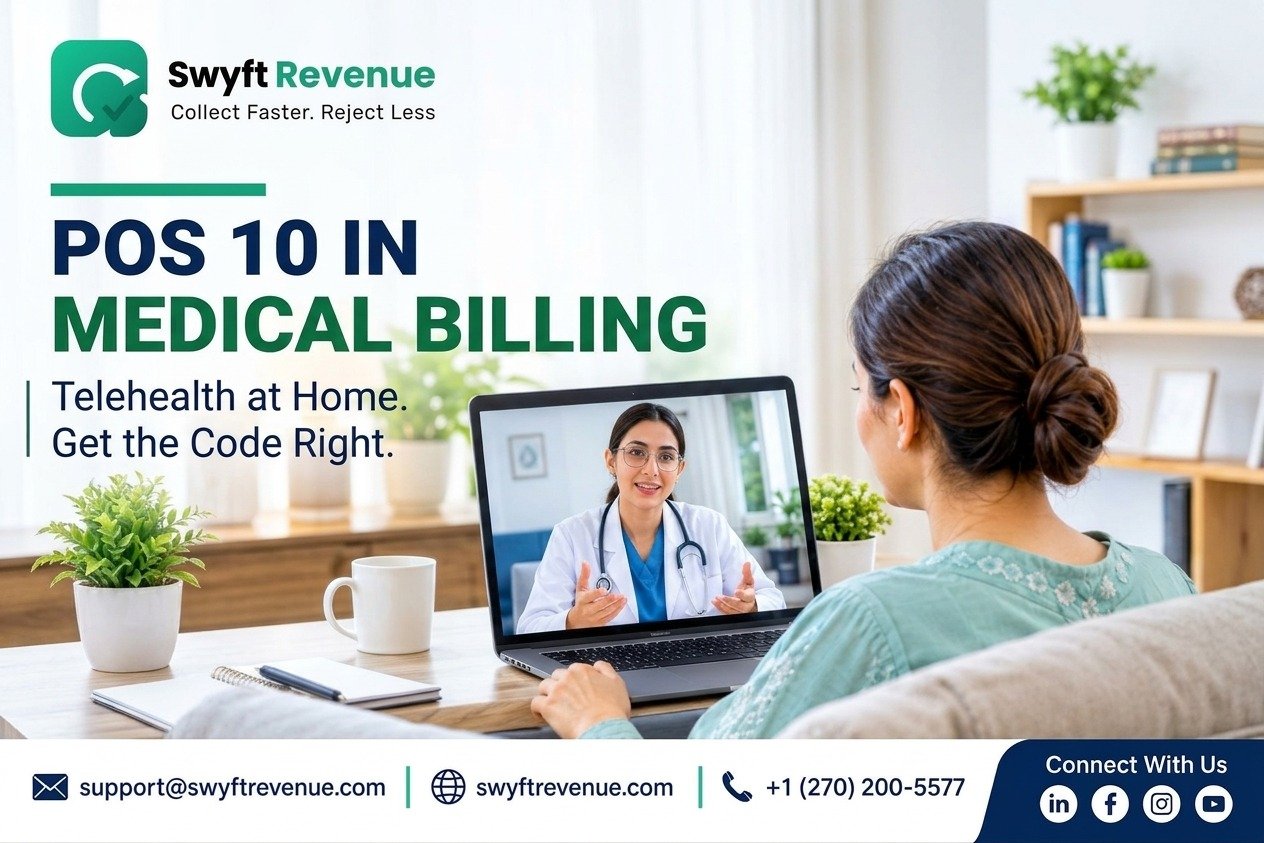
Your provider is on a video call with a patient. The visit goes well, the note is complete, and the claim goes out. But if the place of service is wrong, the payment can be wrong too.
That is why “POS 10 in medical billing” is a growing search. As telehealth became a permanent part of care, one small two-digit code started deciding how claims are paid, and many practices still get it wrong.
What Is a Place of Service (POS) Code?
A place of service code tells the payer where the patient received care. It sits on every professional claim and affects how the payer prices the service. For telehealth, two codes matter most.
POS 10 vs. POS 02: The Difference
| Code |
Meaning |
Use it when |
| POS 10 |
Telehealth provided in the patient’s home |
The patient is at their private residence |
| POS 02 |
Telehealth provided other than in the patient’s home |
The patient is at a clinic, facility, or other eligible location |
For Medicare, “home” generally means a private residence, not a hospital or other facility. The question isn’t where the provider is sitting. It is where the patient is.
Why This Code Affects Your Payment
Since January 1, 2024, Medicare has paid home-based telehealth (POS 10) at the non-facility rate. That makes this a payment issue, not just a coding formality.
A single wrong digit can lead to:
- Underpayment, if a home visit is coded with the wrong POS
- Denials, if the POS doesn’t match the service or payer rules
- Audit exposure, if claims consistently misrepresent the patient’s location
Mistakes Practices Make
- Using POS 11 (office) for telehealth. The visit wasn’t in the office, so the claim doesn’t reflect reality.
- Using one telehealth code for every visit. POS 02 and POS 10 are not interchangeable.
- Not recording where the patient was. If the EHR doesn’t capture it, billers are left guessing.
- Assuming every payer follows Medicare. Many commercial payers do, but not all, and modifier rules differ.
- Mixing up modifiers. Medicare doesn’t require modifier 95 with POS 10, but some commercial payers still expect it, and audio-only services may call for a different modifier.
Medicare Telehealth Flexibilities Through 2027
Congress extended key Medicare telehealth flexibilities through December 31, 2027, including allowing the patient’s home as an eligible location. That gives practices breathing room, but these are temporary rules, not permanent ones. Practices should build clean POS habits now rather than rely on deadlines that could shift.
Always confirm current requirements with each payer, because Medicare policy and commercial contracts don’t always match.
A Simple Telehealth Billing Checklist
- Ask at check-in: “Where are you right now?” and document the answer.
- Add a required patient-location field to your telehealth EHR template.
- Map patient home to POS 10, and any other eligible site to POS 02.
- Check each payer’s rules on modifiers 95 and 93 before billing.
- Review denials weekly for telehealth-related patterns.
- Train front desk, providers, and billers on the same definitions.
- Keep records of consent, platform used, and visit type.
How Swyft Revenue Helps
Small practices rarely have time to track every payer’s telehealth rules. Swyft Revenue’s medical billing services keep the details in order so claims go out right the first time:
- Billing and coding review with place of service and modifiers checked before submission
- A 96.2% clean claim rate, with claims scrubbed and submitted daily
- Eligibility verification so coverage issues surface before the visit
- Denial management, with denied claims corrected and resubmitted within 48 hours
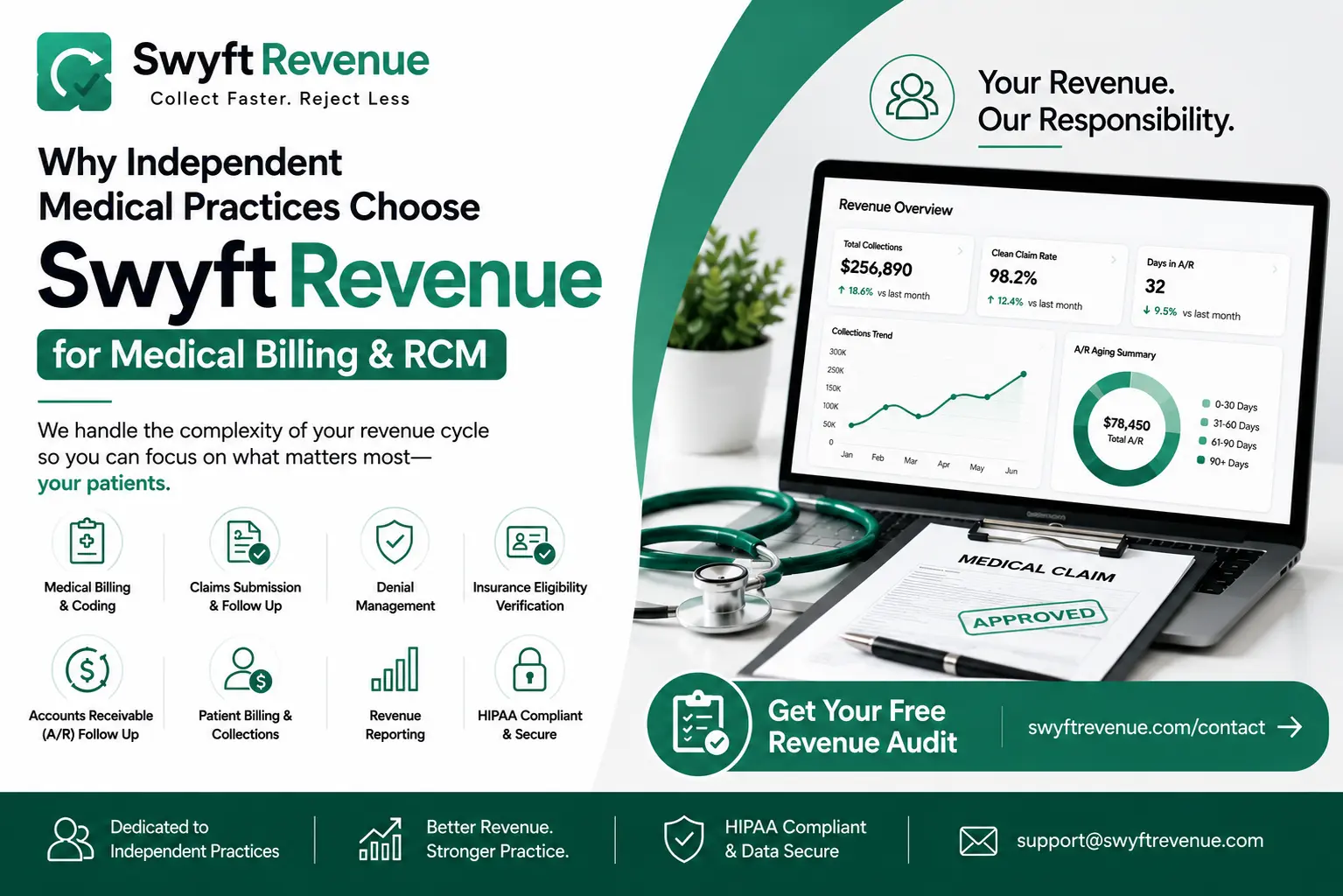
- A real-time dashboard showing total billed, total collected, and A/R aging 24/7
- A dedicated, U.S.-based account manager who knows your payers
There are no long-term contracts, and pricing is 3-5% of collections, starting from 2.99%. If you’re weighing whether to outsource medical billing services, ask any company how it handles telehealth POS and modifier rules. It’s a quick test of how closely they work with your claims.
Make Every Telehealth Visit Count
Telehealth is now part of routine care, and your billing needs to keep up. A correct POS code is a small detail that protects both revenue and compliance.
Get a free revenue audit and see whether telehealth claims are being paid correctly.
📧 support@swyftrevenue.com | 🌐 swyftrevenue.com/contact | 📞 +1 (270) 200-5577
SwyftRevenue: Your Revenue. Our Responsibility.