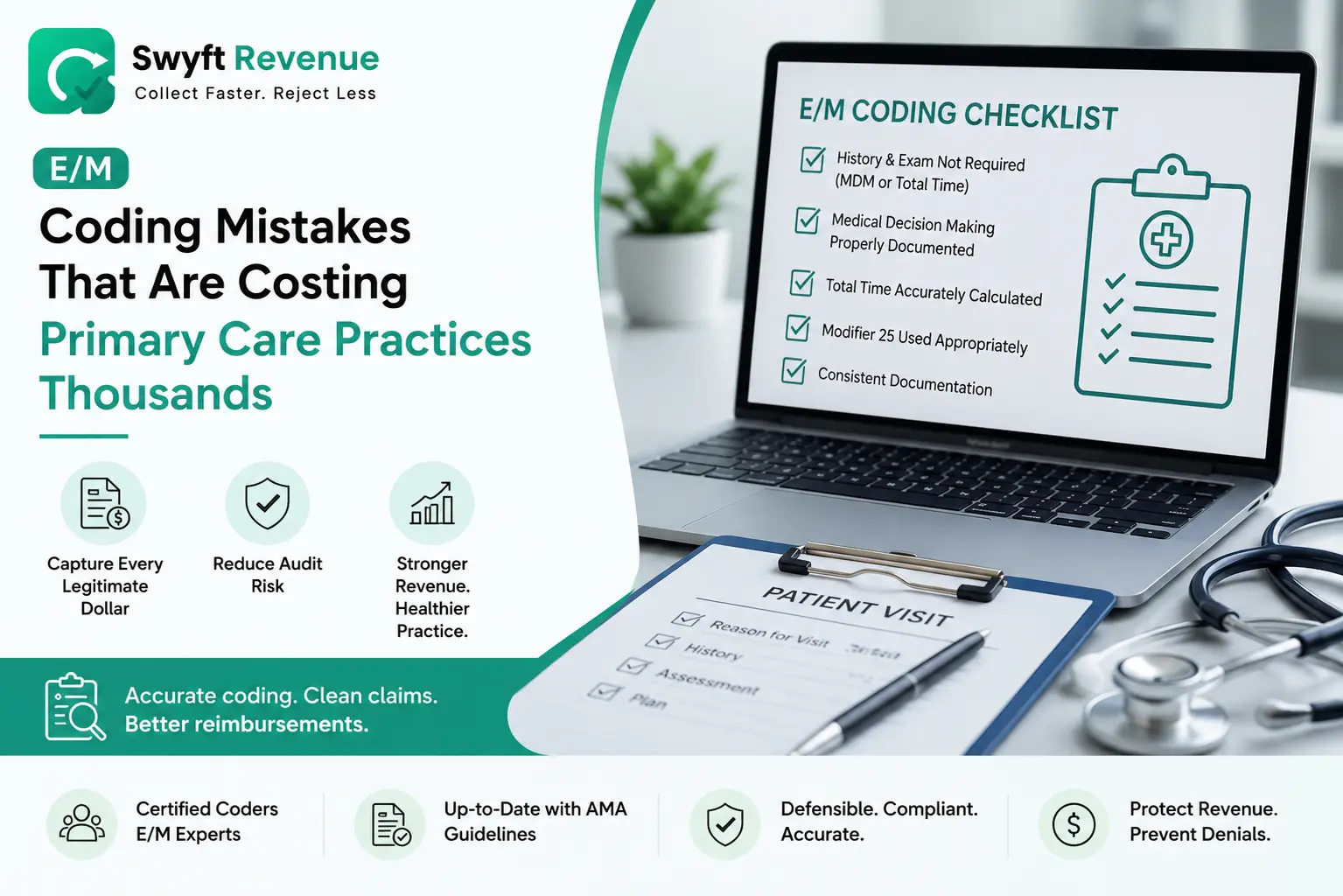
E/M Coding Mistakes That Are Costing Primary Care Practices Thousands
Aug 21, 2026
Evaluation & Management (E/M) coding is the backbone of primary care billing nearly every patient visit runs through it....
Read More →

Medicare is a major source of healthcare coverage for older Americans, making Medicare medical billing an essential part of the revenue cycle for many U.S. healthcare practices.
However, submitting a claim does not always mean receiving payment without further work. Practices can encounter claim rejections, Medicare claim denials, delayed responses, coding issues, documentation concerns, and unresolved accounts that continue aging.
For physicians and practice managers, the real challenge is often not submitting the claim. It is managing everything that happens when the claim does not get paid as expected.
This is where professional Medicare billing services can help.
Why Medicare Claims Can Become Difficult
Medicare claims are subject to specific billing, coding, coverage, and payment requirements. Medicare Fee for Service claims are processed through Medicare Administrative Contractors (MACs), which handle claims for designated geographic areas.
This can make the billing process demanding for practices managing a high volume of Medicare patients.
Common problems can include:
When these problems remain unresolved, the practice may have revenue sitting in A/R instead of reaching its bank account.
Why Medicare Claims Get Delayed
One question many providers ask is: Why Medicare claims get delayed even after the claim has been submitted.
The answer can depend on the individual claim and the circumstances surrounding its processing.
A billing team may need to determine whether the claim was received, identify its current status, understand a payer response, and determine what needs to happen next.
Medicare provides different methods for checking claim information, but accessing a claim status is only one part of the process.
Someone still has to understand the account and work it.
For a busy practice, repeatedly managing unresolved Medicare claims can consume valuable staff time.
The Communication Challenge in Medicare Billing
Healthcare practices increasingly interact with automated telephone systems, online portals, and electronic claim processing systems.
These channels can provide information, but billing teams may still encounter situations where claim terminology, codes, identifiers, or payer responses require careful interpretation.
A response that appears simple may require additional billing review before the account can move forward.
This is particularly important when a practice has a large number of Medicare claims in different stages of processing.
The objective should not simply be to obtain another claim status.
The objective is to move the claim toward resolution.
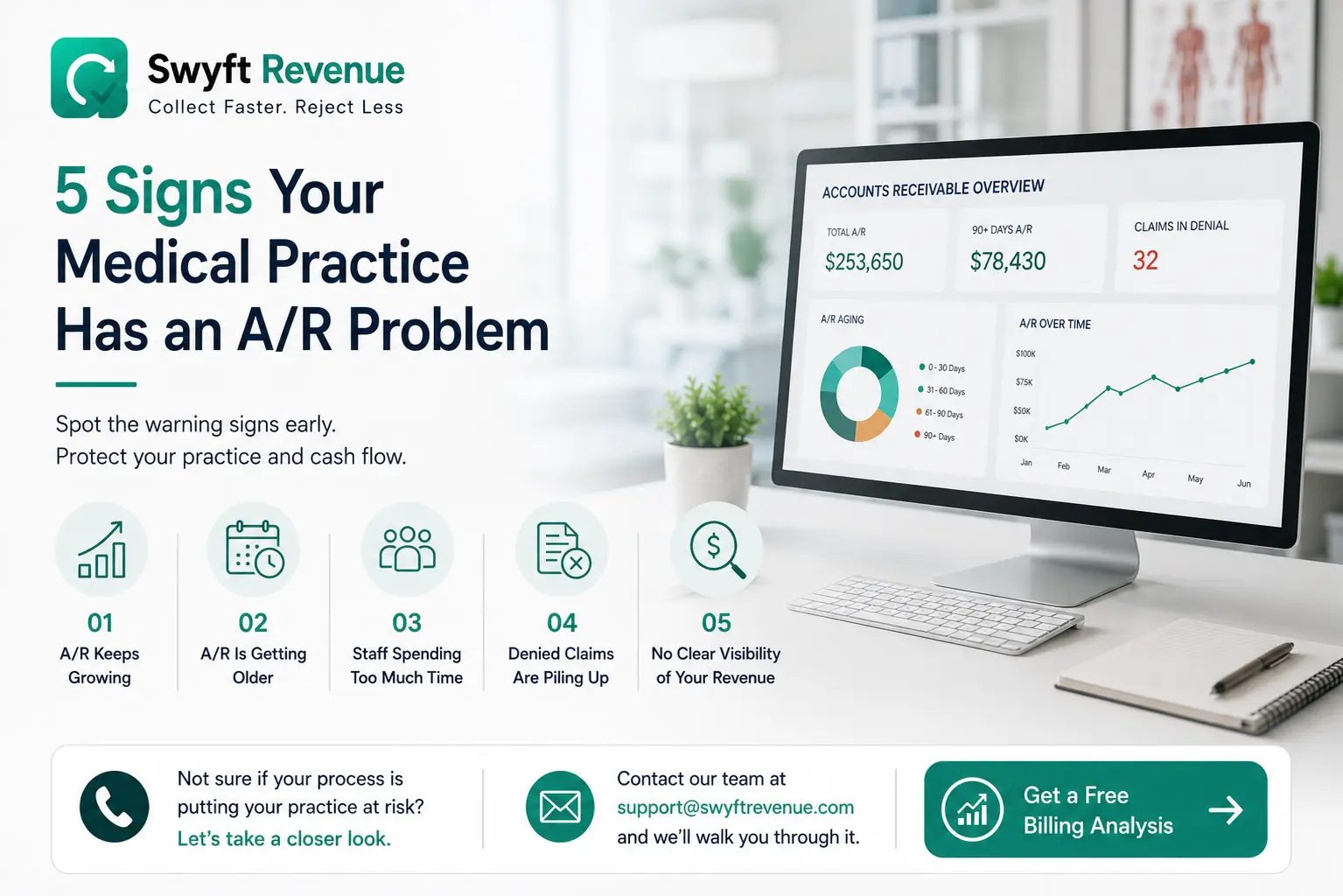
When Medicare A/R Starts Growing
One unresolved claim may not seem significant.
But when dozens or hundreds of accounts remain outstanding, the effect can become much more noticeable.
Growing aging Medicare accounts receivable can contribute to:
This is why Medicare A/R follow up is an important part of effective Medicare RCM.
The longer an account remains unresolved, the more attention it may require.
Medicare Claim Denials Need Dedicated Attention
A denied claim should not simply disappear into an aging A/R report.
Medicare claim denials can have different causes, and the appropriate billing response depends on the circumstances of the individual claim.
CMS provides information regarding Medicare claim review and denial reasons. However, identifying a denial reason is only the beginning.
The real workload involves reviewing the account, determining the appropriate next action, completing the required billing work, and following the claim through the revenue cycle.
That is why many practices turn to professional Medicare denial management services rather than placing the entire responsibility on their existing office staff.
Why In House Medicare Billing Can Become Overwhelming
Medical practices already have to manage patients, providers, appointments, documentation, staffing, and daily operations.
At the same time, their billing teams may be expected to manage:
As the volume of work increases, unresolved claims can receive less attention.
And when claims remain unresolved, the practice may have revenue sitting in its accounts receivable for longer than necessary.
The Solution: Outsourced Medicare Billing
Instead of making physicians or office staff responsible for every billing issue, practices can work with a specialized Medicare billing partner.
This provides the practice with dedicated billing support focused on managing the revenue cycle.
At Swyft Revenue, we provide outsourced Medicare billing for U.S. healthcare practices that need additional support managing Medicare claims and outstanding A/R.
Our team can support your practice with:
Medicare Medical Billing
We help manage the Medicare billing process and support claims throughout the revenue cycle.
Claims Submission & Follow Up
Submitting a claim is only the beginning. Our team provides continued attention to outstanding claims and billing accounts.
Medicare Denial Management Services
When a Medicare claim is denied, our billing team reviews the account and works toward appropriate resolution.
Medicare A/R Recovery
Unpaid claims can represent revenue that your practice has already earned. Our Medicare A/R recovery support focuses on outstanding balances that require attention.
Eligibility Verification
Our team supports insurance eligibility verification as part of a more organized billing workflow.
Medicare Revenue Cycle Management
Our Medicare revenue cycle management support looks beyond individual claims and focuses on the overall movement of revenue through your practice.
Why Practices Choose Swyft Revenue
Partnering with a billing company is not simply about transferring administrative work.
It is about having a dedicated team focused on the revenue that remains outstanding.
With Swyft Revenue, practices can benefit from:
Reduced Administrative Pressure
Your internal staff can spend less time managing unresolved Medicare billing accounts.
Dedicated A/R Support
Outstanding balances receive ongoing attention instead of simply remaining on an aging report.
Denial Management Support
Denied claims become part of an organized follow up process.
Better Revenue Visibility
A structured billing process can help practices better understand where outstanding revenue sits within the cycle.
Specialized Medicare Support
Medicare billing involves specific requirements and workflows. Professional billing support allows your practice to have experienced resources focused on these responsibilities.
Who Can Benefit From Medicare Billing Services?
Professional Medicare billing services can support:
If your staff is spending too much time dealing with Medicare claims instead of running the practice, professional billing support may be worth considering.
Healthcare Revenue Audit for Medicare
Sometimes the issue is not one individual claim.
A practice may need to understand where revenue is being delayed across its broader billing operation.
A healthcare revenue audit for Medicare can help identify areas within the revenue cycle that deserve closer attention.
At Swyft Revenue, our revenue cycle expertise allows us to look beyond individual billing transactions and examine the broader revenue process.
The goal is to identify where your revenue is getting stuck and help your practice move it forward.
How Swyft Revenue Supports Your Revenue Cycle
Swyft Revenue provides comprehensive medical billing and Medicare RCM support for U.S. healthcare providers.
Our services include:
You provide the care.
We focus on the revenue cycle behind it.
Areas We Cover
Swyft Revenue provides medical billing and revenue cycle management services across all 50 U.S. states, including California, Texas, Florida, New York, Pennsylvania, Illinois, Ohio, Georgia, North Carolina, Michigan, New Jersey, Virginia, Washington, Arizona, Massachusetts, Tennessee, Indiana, Missouri, Maryland, Wisconsin, Colorado, Minnesota, South Carolina, Alabama, Louisiana, Kentucky, Oregon, Oklahoma, Connecticut, Utah, Iowa, Nevada, Arkansas, Mississippi, Kansas, New Mexico, Nebraska, West Virginia, Idaho, Hawaii, New Hampshire, Maine, Montana, Rhode Island, Delaware, South Dakota, North Dakota, Alaska, Vermont, and Wyoming, as well as Washington, D.C.
FAQs
Why do Medicare claims get delayed?
Medicare claims can experience delays for different reasons involving claim information, coding, coverage, documentation, processing, or other payment requirements. The specific reason varies by claim.
What is Medicare A/R follow up?
Medicare A/R follow up involves managing outstanding Medicare accounts and working unresolved claims through the revenue cycle.
What is Medicare denial management?
Medicare denial management involves reviewing denied claims and managing the appropriate billing follow up needed to pursue resolution.
What is outsourced Medicare billing?
Outsourced Medicare billing means using an external medical billing company to support billing activities such as claims, denials, A/R, and revenue cycle management.
Why use a Medicare billing partner?
A Medicare billing partner gives practices dedicated billing resources without requiring physicians and internal staff to manage the entire Medicare billing workload themselves.
Does Swyft Revenue provide Medicare billing services?
Yes. Swyft Revenue provides Medicare medical billing, denial management, A/R recovery, claims follow up, and broader Medicare RCM support for U.S. healthcare practices.
Conclusion
Medicare billing can become a significant administrative challenge when claims are denied, delayed, or left unresolved.
For practices with a growing Medicare patient population, aging A/R and repeated claim issues can mean more administrative work and revenue that remains uncollected.
Your physicians should be focused on patients—not spending their day chasing unresolved Medicare claims.
Let Swyft Revenue put the focus back on your revenue cycle.
Swyft Revenue — Your Revenue. Our Responsibility.
📧 support@ Swyft Revenue.com
🌐 Swyft Revenue.com/contact