Growing a Dental Support Organization (DSO) means coordinating billing, insurance claims, and financial operations across multiple dental offices. As the network expands, managing these processes consistently becomes increasingly difficult.
A busy schedule does not automatically translate into timely payments. Claims can remain unresolved, denials can create additional administrative work, and outstanding accounts receivable can accumulate while teams struggle to keep up with daily responsibilities.
This is the DSO billing efficiency paradox: an organization can increase its clinical activity while its billing processes struggle to keep pace.
Swyft Revenue helps healthcare organizations manage essential medical billing and revenue cycle workflows, providing support with claims, denials, accounts receivable, and reporting. For growing DSOs, the first step is understanding where professional RCM support can address existing operational challenges.
Why Is Dental Billing Management Challenging for Growing DSOs?
Managing revenue across multiple locations requires consistent processes, clear responsibilities, and reliable oversight. Without them, problems at individual offices can become network-wide administrative challenges.
Common issues include:
- Growing accounts receivable: Outstanding claims require timely follow-up to prevent avoidable delays.
- Recurring denials: Incorrect or incomplete information can lead to rejected or denied claims and additional work.
- Inconsistent office procedures: Different locations may use different workflows for insurance verification, claim submission, and payment posting.
- Limited financial visibility: Leadership needs accurate reporting to understand which locations and payers require attention.
- Staffing constraints: Internal teams may struggle to manage increasing claim volumes alongside daily administrative duties.
- Expansion-related disruption: Integrating acquired practices can introduce different billing systems, processes, and reporting standards.
These challenges explain why DSO revenue cycle management requires more than processing claims. Organizations need a structured approach to monitoring outstanding payments, identifying recurring issues, and maintaining consistent billing operations as they expand.
How Swyft Revenue Supports Multi-Location Billing
Swyft Revenue provides medical billing and revenue cycle support to help healthcare organizations manage essential billing responsibilities. Depending on the organization's specialty and agreed scope, several services may address important gaps in existing workflows.
Medical Billing and Claims Management
A reliable billing process helps ensure that claims move through submission and follow-up without unnecessary administrative delays.
Swyft Revenue supports medical billing workflows, including claim submission and follow-up, helping eligible organizations manage billing tasks more systematically.
For multi-location groups, the objective is to establish clear ownership of outstanding claims and reduce the burden on internal teams that are already managing daily operations.
DSO Denial Management Services
A denied claim may require correction, supporting documentation, an appeal, or another appropriate action depending on the payer's explanation and requirements.
Swyft Revenue's denial management capabilities help eligible healthcare organizations review denial issues, coordinate next steps, and track unresolved claims.
Identifying recurring denial patterns also helps organizations recognize where billing workflows may need improvement. Addressing underlying issues can reduce repeated rework and help teams handle future claims more consistently.
Dental A/R Management for Multi-Location Practices
Outstanding accounts receivable can make cash flow harder to anticipate and obscure the status of unpaid claims.
An organized A/R process prioritizes follow-up based on claim age, outstanding balance, payer response, and the action required to move each claim forward.
Swyft Revenue offers A/R follow-up and recovery support for applicable engagements. This can help organizations maintain a more consistent approach to outstanding claims rather than allowing older balances to remain unattended.
Insurance Eligibility and Front-End Support
Insurance verification is an important part of preventing billing complications. Incorrect member information, incomplete details, or misunderstandings about coverage can contribute to downstream claim problems.
Real-time dental insurance verification may help dental organizations identify relevant coverage information earlier, where supported by their systems and payer workflows.
DSOs should review their existing verification processes and confirm the availability of any dental-specific verification capabilities when discussing services with Swyft Revenue.
Payment Posting and Revenue Cycle Reporting
Leadership needs to understand what has been paid, what remains outstanding, and where further action is required.
Swyft Revenue offers payment posting and revenue cycle reporting capabilities within its broader RCM services, subject to the agreed engagement.
Consistent reporting can help organizations review billing activity, identify bottlenecks, and make more informed decisions about where additional operational attention is needed.
How Can DSOs Improve Billing Efficiency With Automation?
DSO dental RCM automation is increasingly relevant as organizations manage growing volumes of claims and information across multiple offices.
Automation can support repetitive administrative tasks, reduce manual data handling, and help teams identify exceptions that need attention. Examples may include eligibility checks, workflow notifications, claim-status monitoring, and reporting, depending on the technology in use.
However, automation alone cannot resolve every billing problem. Inaccurate information, complex payer requirements, documentation gaps, and disputed claims may still require experienced staff to review the issue and determine the appropriate response.
For DSOs, the objective should be to combine suitable technology with clearly defined workflows and accountable follow-up.
Swyft Revenue provides billing and RCM support that organizations can evaluate alongside their existing systems. Discuss your technology environment and requirements with the team to determine which workflows can be supported.
Should a DSO Outsource Revenue Cycle Management?
Outsourcing can be useful when internal billing teams lack the capacity to keep up with claim volumes, denials, or outstanding receivables.
Building an internal department requires recruitment, training, supervision, and ongoing investment. For a growing network, outsourced DSO billing services offer another way to supplement existing resources without assuming every function must be transferred to an external partner.
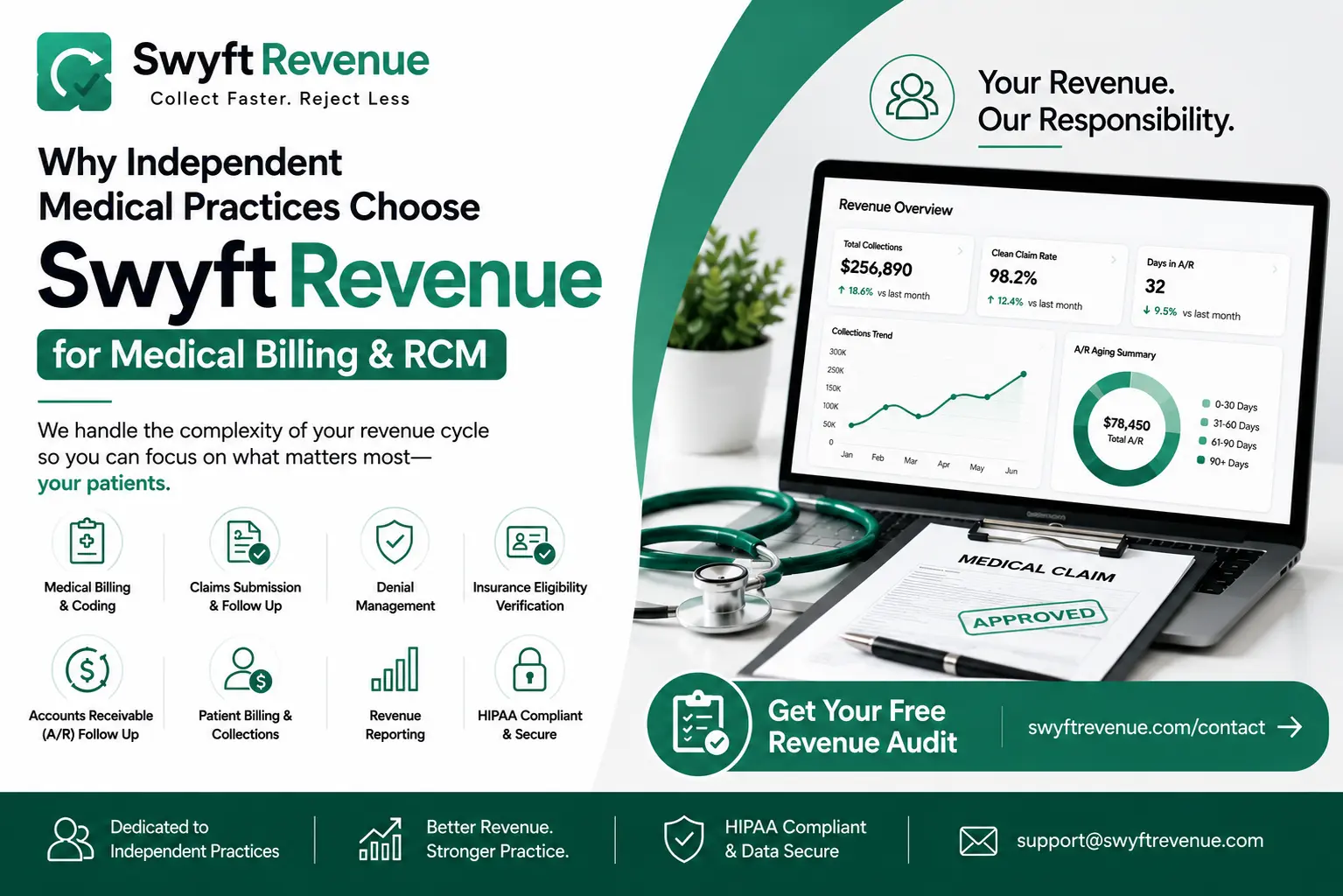
Swyft Revenue can help eligible healthcare organizations explore support for:
- Medical billing and claim follow-up.
- Denial management and claim recovery.
- Accounts receivable follow-up.
- Eligibility verification.
- Payment posting.
- Revenue cycle reporting.
The right approach depends on the organization's specialty, payer mix, software, staffing, and operational priorities. Dental-only DSOs should specifically confirm support for CDT coding, dental claims, dental payer workflows, and their practice-management systems before entering an engagement.
How to Get Started With Swyft Revenue
Choosing a multi-office revenue cycle management partner should begin with an assessment of your current operations.
Step 1: Identify your biggest billing challenge. Determine whether aged A/R, recurring denials, staffing limitations, or inconsistent reporting is creating the most pressure.
Step 2: Review your current workflows. Examine how claims are submitted, monitored, corrected, and escalated across your locations.
Step 3: Request a Free Healthcare Revenue Audit. Contact Swyft Revenue to discuss your billing challenges and explore potential opportunities to improve your revenue cycle. Confirm the audit's scope and information requirements with the team.
Step 4: Define your service requirements. Discuss your specialties, payer mix, software, existing billing resources, and the functions you want to outsource.
Step 5: Establish measurable objectives. Depending on the engagement, relevant measures may include A/R aging, denial trends, follow-up timeliness, and outstanding claims.
This process helps determine whether Swyft Revenue's services fit your organization and creates a clear foundation for evaluating progress.
Why Choose Swyft Revenue for DSO Revenue Cycle Management?
When billing problems consume time and attention, leadership needs a practical way to address them without losing sight of broader organizational goals.
Swyft Revenue helps eligible healthcare organizations manage essential revenue cycle activities through professional billing support, denial management, A/R follow-up, payment posting, and reporting.
Rather than treating each outstanding claim as an isolated task, a structured RCM approach connects these activities and gives billing teams clearer processes for handling unresolved issues.
For growing organizations, this means having a partner to discuss existing bottlenecks, evaluate service requirements, and establish workflows aligned with agreed objectives.
Your clinical teams focus on patient care. Swyft Revenue helps manage the billing work behind your revenue cycle.
Frequently Asked Questions
How do DSOs manage revenue cycles across multiple locations?
DSOs can standardize billing procedures, establish clear claim follow-up responsibilities, monitor denials and A/R, and use consistent reporting to identify issues across their network.
How can a DSO reduce accounts receivable?
A structured process for prioritizing aged claims, monitoring payer responses, resolving outstanding issues, and assigning follow-up responsibilities can help organizations manage A/R more effectively.
Can Swyft Revenue provide outsourced DSO billing services?
Healthcare organizations can contact Swyft Revenue to discuss outsourced medical billing and RCM support. Dental-specific capabilities, systems compatibility, and service scope should be confirmed before engagement.
Can automation prevent every dental billing denial?
No. Automation may help identify errors and improve administrative consistency, but documentation issues, payer requirements, and complex claim decisions can still require human review.
How can a DSO request a multi-site healthcare revenue audit?
Visit Swyft Revenue's contact page or email support@Swyft Revenue.com to discuss your requirements and ask about the Free Healthcare Revenue Audit.
Strengthen Your DSO's Revenue Cycle With Swyft Revenue
As a dental support organization expands, its billing processes must keep pace. Unresolved claims, recurring denials, and inconsistent follow-up can create additional administrative work and make financial performance harder to monitor.
Swyft Revenue helps eligible healthcare organizations explore professional billing and revenue cycle support based on their operational needs.
Start by identifying where your existing workflows need attention and discussing which services may address those challenges.
Request your Free Healthcare Revenue Audit.
Contact: https://Swyft Revenue.com/contact
Email: 📧 support@Swyft Revenue.com