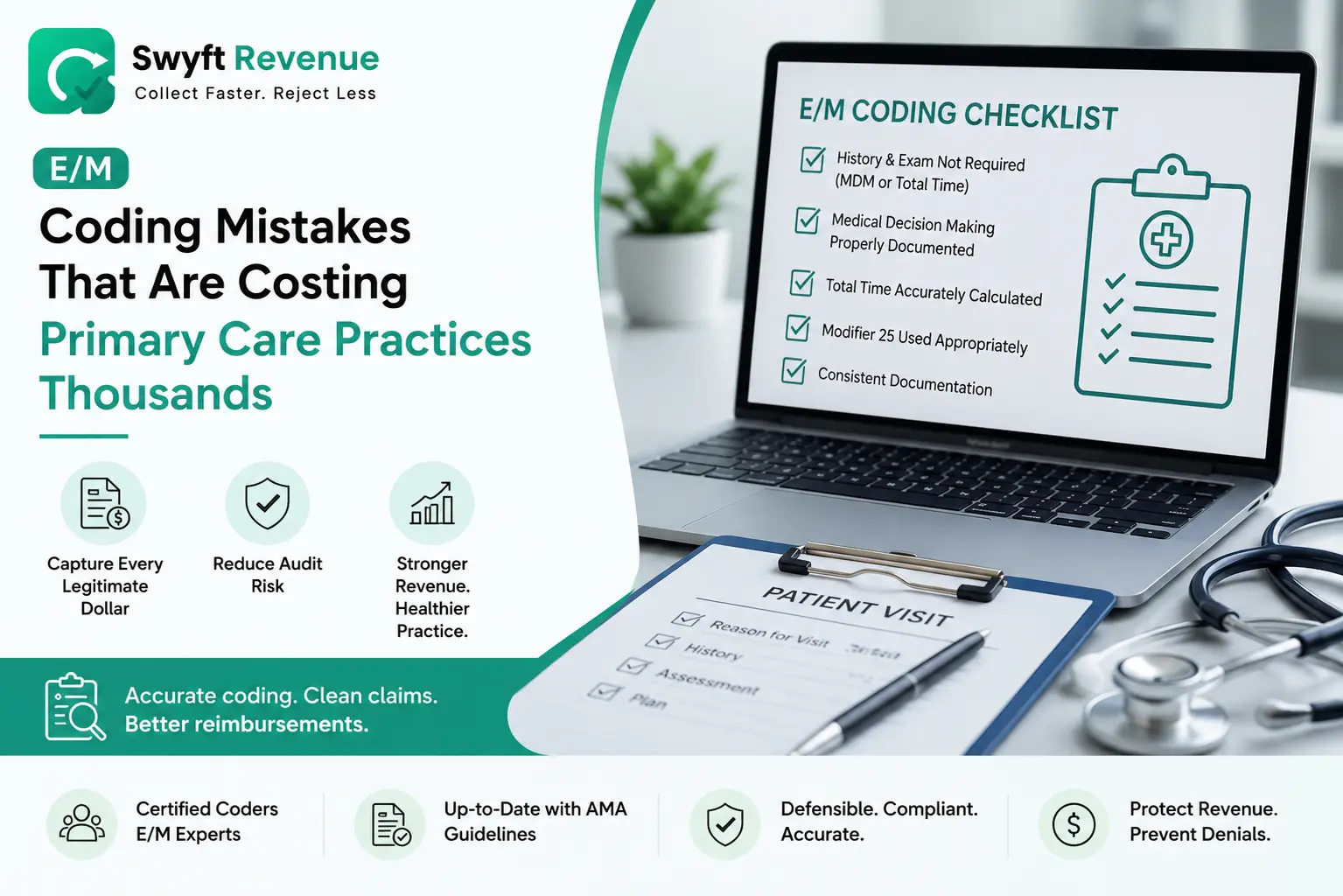
E/M Coding Mistakes That Are Costing Primary Care Practices Thousands
Aug 21, 2026
Evaluation & Management (E/M) coding is the backbone of primary care billing nearly every patient visit runs through it....
Read More →
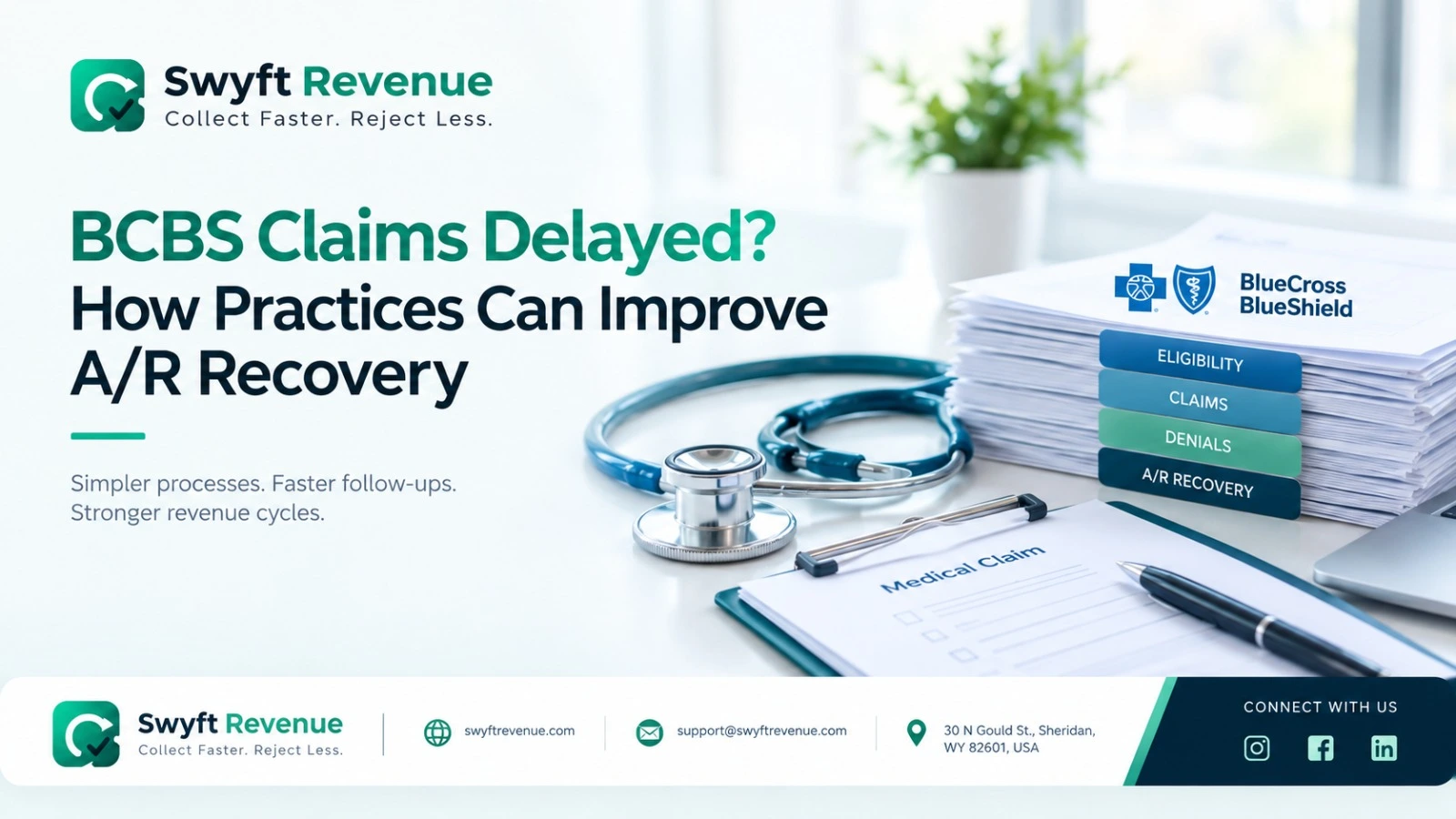
For many U.S. medical practices, BCBS medical billing is an important part of the revenue cycle. Blue Cross Blue Shield (BCBS) serves millions of Americans through independent, locally operated BCBS companies. Because plans and processes can vary, practices may face challenges with eligibility, claim status, authorization, denials, and unpaid balances.
When claims remain unresolved, the problem goes beyond one unpaid claim. A growing backlog can increase aging accounts receivable (A/R), consume staff time, and affect practice cash flow.
The solution is not simply making more payer calls. Practices need a structured process for BCBS claim follow up, denial management, and A/R recovery.
Why BCBS Claims Can Become Difficult to Manage
One important point is that BCBS is not a single national insurance company processing every claim through one system. The Blue Cross Blue Shield Association represents independent BCBS companies operating in different markets.
This means providers need to work with the appropriate plan and understand the requirements connected to each patient's coverage.
Problems can arise from:
When these issues are not tracked consistently, unresolved BCBS claims can gradually become aging A/R.
The Real Problem Is Often Unworked A/R
Submitting a claim does not guarantee payment.
Once a claim has been submitted, practices need to know what happened next. Is it pending? Was it denied? Was additional information requested? Was it processed but not paid as expected?
This is where BCBS A/R follow up becomes important.
A strong billing workflow separates outstanding claims by status and age. This allows billing teams to identify which claims need immediate attention rather than treating every unpaid balance the same way.
The objective should be simple:
Move outstanding claims toward resolution before they become old A/R.
Why Repeated Payer Calls May Not Solve the Problem
When a claim is unpaid, calling the payer may seem like the obvious solution. However, repeated calls without reviewing the claim history can consume significant staff time.
Before contacting the appropriate BCBS plan, the billing team should have relevant information available, including:
This turns a general inquiry into targeted BCBS claim follow up.
The goal is not to make more calls. The goal is to make follow up more productive and get claims resolved.
Eligibility Verification Can Prevent Billing Problems
Revenue cycle problems can begin before a claim is submitted.
Insurance eligibility verification helps practices confirm applicable coverage and obtain the information needed for their billing workflow.
If inaccurate insurance information is used, the practice may spend additional time correcting claims or resolving avoidable billing issues.
For practices treating a large number of BCBS patients, consistent eligibility processes can help reduce preventable problems before they reach the A/R department.
Prior Authorization and the Revenue Cycle
Prior authorization can also affect medical billing workflows.
In 2026, BCBS reported an 11% reduction in prior authorization volume across participating markets, representing approximately 6.5 million fewer prior authorizations. BCBS also reported efforts to improve communication and expand electronic authorization processes.
However, practices should not assume that authorization requirements are identical across every BCBS plan. Requirements can depend on the specific plan, service, and market.
For providers, the takeaway is clear: authorization workflows still need to be monitored carefully.
How Practices Can Improve BCBS A/R Recovery
1. Verify Coverage
Confirm patient insurance information before services and billing whenever possible.
2. Submit Accurate Claims
Review claims for accurate patient, provider, coding, and other required information before submission.
3. Track Claims
Do not consider a claim finished simply because it was submitted. Monitor its progress until it reaches a final resolution.
4. Prioritize Aging A/R
Identify older outstanding balances and establish a consistent follow up process.
5. Analyze Denials
Look beyond individual denials. Recurring denial patterns may indicate a larger workflow issue.
6. Document Follow Up
Keep relevant notes about payer communication, claim status, reference information, and next steps.
7. Audit Revenue Performance
A healthcare revenue audit for BCBS claims can help identify recurring issues, aging balances, and potential areas of revenue leakage.
BCBS Denial Management Matters
Blue Cross Blue Shield claim denials can create additional work for already busy practice teams.
Effective BCBS denial management services focus on understanding why a claim was not paid and determining the appropriate next action.
Common areas requiring review may include eligibility, authorization, coding, documentation, claim information, coverage, or other plan specific requirements.
Treating every denial the same way can waste time. A better approach is to categorize denials, identify patterns, and determine whether the underlying problem originates in the front end or back end billing process.
This can help practices address recurring problems instead of repeatedly dealing with the same issue.
When Aging BCBS A/R Becomes a Practice Problem
Unpaid claims represent revenue that has not yet reached the practice.
As balances age, practices may experience:
For independent practices, these problems can become especially difficult when a small team is responsible for multiple administrative functions.
That is why RCM for independent medical practices should include consistent claim tracking, denial management, and A/R follow up.
How Outsourced BCBS Billing Can Help
Outsourced BCBS billing gives practices access to additional billing support without requiring the entire workload to remain with internal staff.
Depending on the practice's needs, an outsourced billing team can assist with:
The benefit is not simply having another person make payer calls.
It is having a structured process for identifying, prioritizing, and working outstanding revenue.
How Swyft Revenue Supports Your Revenue Cycle
At Swyft Revenue, we help U.S. medical practices manage billing and revenue cycle challenges that can take valuable time away from their teams.
Our services can support practices with:
Medical Billing & Coding
Accurate and organized billing workflows designed around practice requirements.
Denial Management
Review and follow up of denied claims to identify appropriate next steps.
A/R Follow Up & Recovery
Focused attention on outstanding and aging balances.
Eligibility Verification
Support with front end insurance verification processes.
Revenue Cycle Management
Coordinated support across key stages of the billing cycle.
Healthcare Revenue Audits
Review of billing and A/R activity to identify potential revenue leakage and recurring issues.
If your practice is spending too much time managing unpaid BCBS claims, outsourcing selected billing functions can provide additional capacity and consistency.
Areas We Cover
Swyft Revenue provides medical billing and revenue cycle management services across all 50 U.S. states, including Alabama, Alaska, Arizona, Arkansas, California, Colorado, Connecticut, Delaware, Florida, Georgia, Hawaii, Idaho, Illinois, Indiana, Iowa, Kansas, Kentucky, Louisiana, Maine, Maryland, Massachusetts, Michigan, Minnesota, Mississippi, Missouri, Montana, Nebraska, Nevada, New Hampshire, New Jersey, New Mexico, New York, North Carolina, North Dakota, Ohio, Oklahoma, Oregon, Pennsylvania, Rhode Island, South Carolina, South Dakota, Tennessee, Texas, Utah, Vermont, Virginia, Washington, West Virginia, Wisconsin, and Wyoming, as well as Washington, D.C.
Frequently Asked Questions
Why do BCBS claims remain unresolved?
Claims can require additional review because of eligibility, authorization, claim information, documentation, denials, or plan specific requirements.
Is BCBS one insurance company?
No. BCBS consists of independent, locally operated companies. The appropriate BCBS company depends on the patient's plan and location.
How can practices improve BCBS A/R recovery?
Consistent eligibility verification, accurate claim submission, claim tracking, denial management, and aging A/R follow up can help practices manage outstanding revenue more effectively.
What is BCBS denial management?
It is the process of reviewing denied BCBS claims, understanding the reason for non payment, and taking the appropriate next action.
Can outsourced billing help with BCBS claims?
Yes. Outsourced billing teams can provide additional support for claim follow up, denial management, A/R recovery, eligibility verification, and revenue cycle management.
Conclusion
BCBS claims can become a significant administrative challenge when practices have large volumes of outstanding claims and limited time for follow up.
The answer is not simply more phone calls. Practices need a consistent process for BCBS medical billing, claim tracking, denial management, BCBS A/R follow up, and medical practice A/R recovery.
When outstanding claims are identified, prioritized, and worked consistently, practices gain better visibility into their revenue cycle and can focus their internal resources on patient care and practice operations.
If your practice is struggling with unresolved BCBS claims, aging A/R, or increasing billing workload, Swyft Revenue can help.
Swyft Revenue — Your Revenue. Our Responsibility.
📧 support@swyftrevenue.com
🌐 swyftrevenue.com/contact