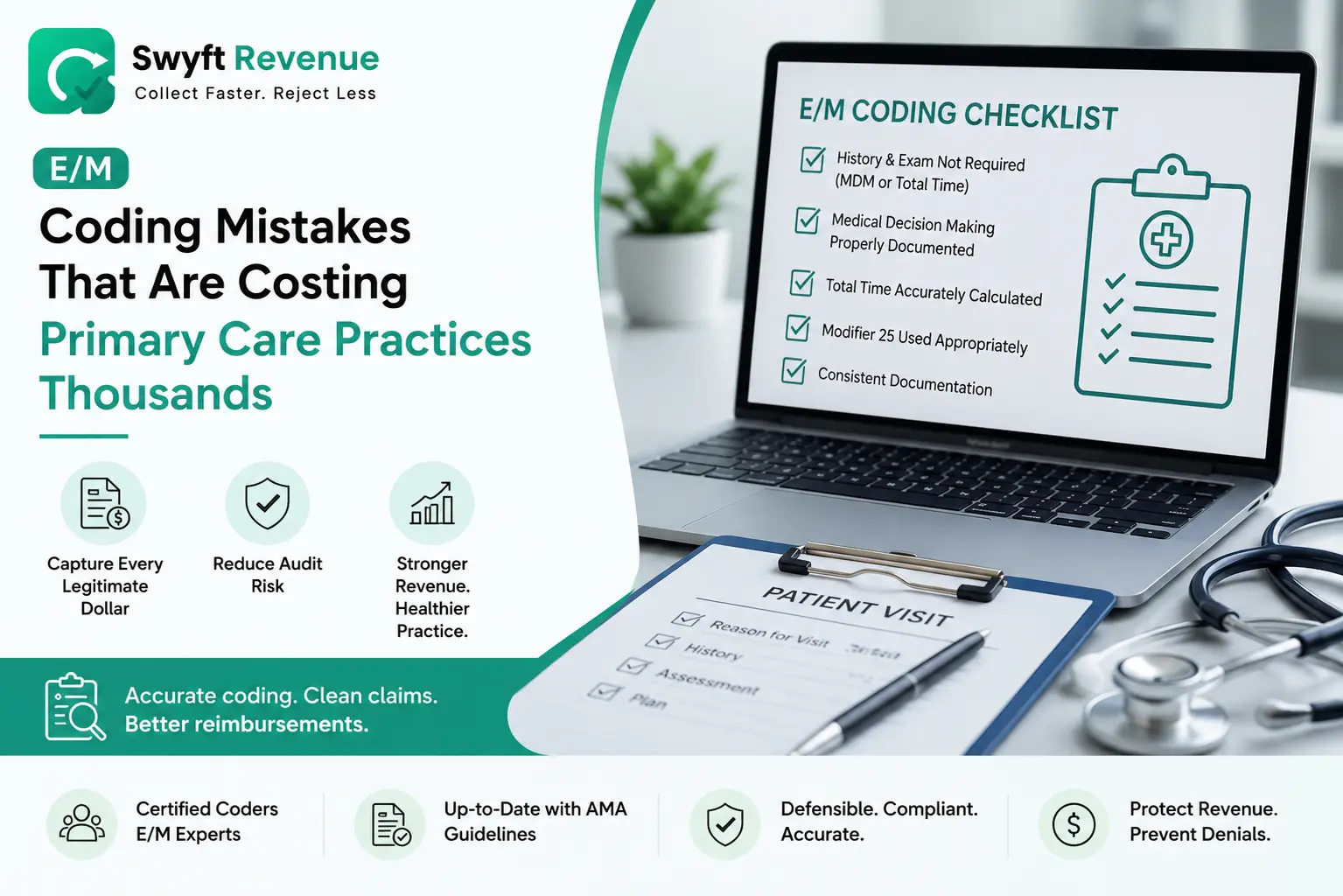
E/M Coding Mistakes That Are Costing Primary Care Practices Thousands
Aug 21, 2026
Evaluation & Management (E/M) coding is the backbone of primary care billing nearly every patient visit runs through it....
Read More →
Running a small medical practice involves much more than patient care. Registration, insurance verification, documentation, coding, claims, payments, patient balances, and accounts receivable (A/R) all need to work together. With a limited administrative team, even one weak point can affect the entire revenue cycle.
These healthcare RCM challenges are especially common in independent practices where the same employees may handle several financial and administrative responsibilities.
The American Medical Association notes that smaller practices may rely on one or two employees for billing, coding, and insurance follow-up, making the process vulnerable when staff are unavailable or important workflows are not documented.
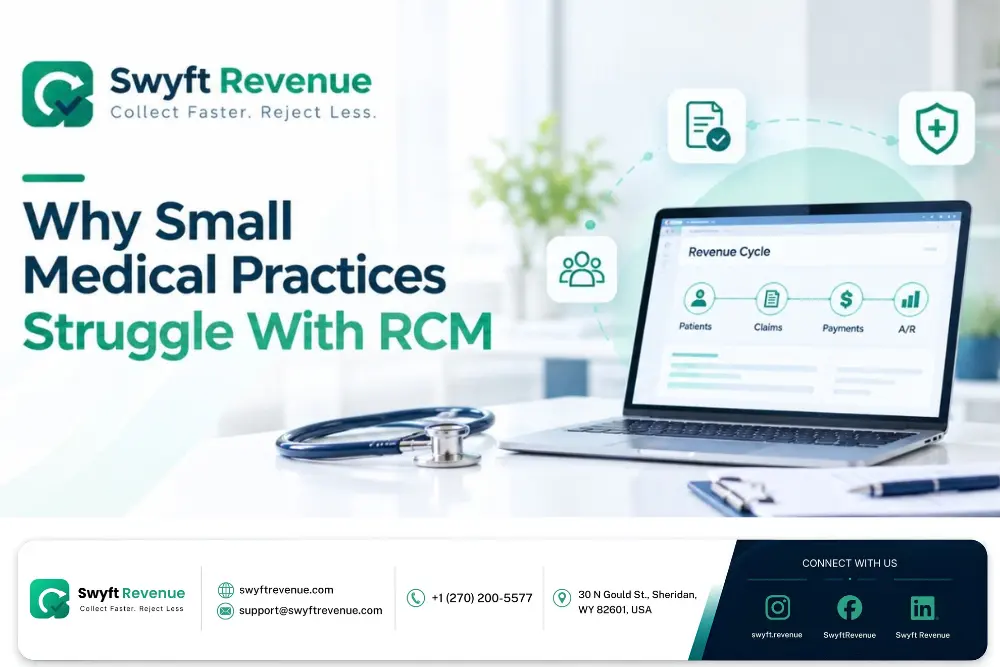
Why Small Medical Practices Struggle With RCM
1. Limited Billing Staff
Small practice medical billing often involves a small team handling multiple responsibilities, including claim submission, payment posting, denial follow-up, insurance verification, patient billing, and A/R.
When claim volume increases, important tasks can be delayed. A denied claim may require attention while new claims are waiting for submission and patient balances need follow-up.
This limited capacity can gradually create an RCM backlog.
2. Single Biller Dependency
Single biller dependency in medical practice can create operational risk. One experienced employee may understand the practice's payers, software, workflows, and recurring billing issues better than anyone else.
If that employee is unavailable or leaves the practice, billing operations can be disrupted.
Documented procedures, shared reporting, and clearly assigned responsibilities can reduce this dependency and make the revenue cycle easier to manage.
3. Disconnected Workflows
Revenue cycle management begins before a claim is submitted. Incorrect patient information, outdated insurance details, missing authorization, or incomplete documentation can create problems later.
For example:
Front desk: incorrect insurance information
Clinical team: incomplete documentation
Billing team: missing claim information
Payer: rejection or denial
A/R team: additional follow-up
Connecting these stages can help practices identify problems earlier and reduce avoidable billing issues.
4. Delayed Claim Follow-Up
Submitting a claim is only one part of the process. Practices also need to monitor whether claims are accepted, rejected, denied, paid, partially paid, or left unresolved.
When follow-up is inconsistent, balances can age and require more administrative work.
This makes preventing claim denials in small clinics and addressing unresolved claims important parts of an effective RCM process.
5. Managing Aging A/R
Managing aging A/R in small practices requires more than knowing the total outstanding balance.
Practice leaders should be able to identify:
Effective medical practice A/R management gives practices greater visibility into where revenue is being delayed. Days in A/R and aging reports can help identify collection problems.
6. Payer Complexity
Different insurers can have different requirements for eligibility, authorization, coding, documentation, claim submission, payment, appeals, and follow-up.
For a small team, keeping up with these requirements can consume significant administrative time. Incorrect or incomplete claim information can also result in rejections or denials.
7. Patient Collections
Patient responsibility can include copayments, deductibles, coinsurance, non-covered services, and outstanding balances.
A consistent process for verifying benefits, communicating expected costs, and collecting appropriate patient responsibility can help reduce unpaid balances.
Effective patient collections and A/R recovery should therefore be part of the overall revenue cycle rather than an isolated billing task.
8. Cash-Flow Delays
RCM problems often build gradually. A few delayed claims may appear manageable, but unresolved claims, denials, unpaid patient balances, and correction work can accumulate.
The practice may continue generating revenue while payments take longer to arrive. This can make cash flow less predictable and increase administrative pressure.
9. Physician Administrative Burden
When billing workflows are not functioning properly, physicians and practice owners may become involved in questions about documentation, coding, denied services, patient balances, insurance requirements, and outstanding claims.
Repeated billing interruptions can take time away from clinical and operational responsibilities.
10. Technology Is Not the Entire Solution
Practice management systems can support patient information, eligibility, billing, collections, and reporting. However, software alone cannot create an effective revenue cycle.
Technology still requires accurate information, proper configuration, trained staff, consistent workflows, monitoring, and human review.
Key RCM Metrics for Medical Practices
Understanding key RCM metrics for medical practices can help owners identify problems before they become larger financial issues.
Important indicators include:
When Should a Practice Consider Outsourced RCM?
Outsourced RCM for small clinics may be worth evaluating when internal resources are no longer sufficient to manage billing consistently.
Common signs include:
Medical billing outsourcing for independent practices can provide additional billing capacity while allowing practice leadership to maintain oversight through reporting, defined responsibilities, and regular A/R reviews.
What Should a Strong Small-Practice RCM Process Include?
A reliable process should connect each stage of the patient-to-payment cycle.
Before the visit: Verify patient information, insurance, authorization requirements, and financial responsibility.
During the visit: Complete documentation and capture accurate charges.
After the visit: Complete coding, submit claims, and monitor acceptance.
Payment processing: Post payments, review payer responses, and identify denials or underpayments.
A/R follow-up: Prioritize aging accounts, work unresolved claims, and address denials.
Patient collections: Communicate financial responsibility and follow up on remaining balances.
Swyft Revenue Medical Billing Support
For practices that need additional capacity, Swyft Revenue medical billing services can support important parts of the revenue cycle.
Swyft Revenue provides small practice RCM services, including:
The focus is not simply on submitting claims. It is on creating a structured process that helps move revenue from patient visit to payment while giving practice leadership better visibility.
Frequently Asked Questions
Why do small medical practices struggle with RCM?
Limited staff, dependence on key employees, payer complexity, and inconsistent follow-up can make the revenue cycle more vulnerable to delays and workflow disruptions.
Why is A/R management important?
A/R management helps practices understand how much revenue remains outstanding, how old balances are, and where follow-up is needed.
How can practices reduce claim denials?
Practices can verify insurance information, identify authorization requirements, maintain accurate documentation, submit complete claims, and monitor payer responses.
When should a practice consider outsourced RCM?
External support may be relevant when A/R is growing, denials are recurring, staff are overloaded, or claims and payment follow-up cannot be handled consistently.
Can practices maintain control when outsourcing?
Yes. Clear responsibilities, regular reporting, A/R reviews, and defined performance expectations can help practices maintain financial oversight.
Conclusion
Small practices face healthcare RCM challenges because limited teams often manage many connected administrative tasks. Delayed claims, denials, aging A/R, payer requirements, and patient balances can become increasingly difficult to manage when follow-up is inconsistent.
A reliable revenue cycle depends on clear workflows, accurate information, regular monitoring, timely follow-up, and appropriate support.
For practices that need additional capacity, Swyft Revenue medical billing and small practice RCM services can provide structured billing support while allowing physicians and staff to remain focused on patient care.
Swyft Revenue — Your Revenue Our Responsibility.
📧 support@ Swyft Revenue.com
🌐 Swyft Revenue.com/contact