One Small Mistake Can Delay an Entire Claim
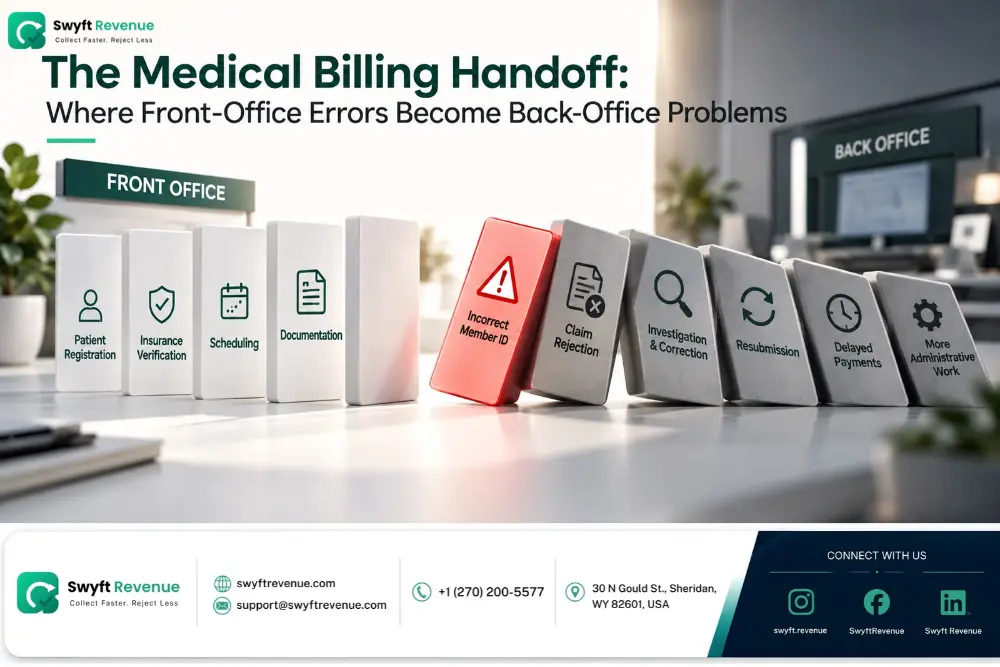
A patient arrives for an appointment. The front desk records their insurance details, the clinician provides care, and the visit appears complete. Days later, the billing team discovers an incorrect member ID or missing referral. The claim now needs investigation, correction, and follow-up.
This is a medical billing handoff problem: information moves between teams, but an error at the beginning can disrupt the rest of the revenue cycle.
Recurring front-office medical billing errors create additional administrative work, delay reimbursement, and leave claims unresolved. For practice managers, the challenge is not simply correcting individual claims. It is identifying where the process breaks down and preventing the same issues from recurring.
Swyft Revenue supports medical billing, denial management, accounts receivable recovery, payment reconciliation, and reporting to help practices manage essential back-office revenue cycle functions.
What Is the Medical Billing Handoff?
The medical billing handoff is the transfer of information and responsibilities between the teams involved in a patient’s visit and the resulting insurance claim.
The front office typically manages registration, demographic details, insurance information, and appointment requirements. Clinical staff document the care provided, while the billing team uses the relevant records to prepare and submit claims, post payments, and follow up on outstanding balances.
A reliable revenue cycle management handoff process ensures that each team receives accurate information and knows who is responsible for resolving outstanding issues.
When information is incomplete or responsibilities are unclear, problems may not surface until a claim is rejected, denied, or delayed.
How Do Front-Office Errors Cause Medical Claim Denials?
Not every front-end error results in a denial. Some claims are rejected before adjudication, while others are denied after payer review. Understanding this distinction helps practices direct problems to the right team.
Patient Registration Errors in Medical Billing
Incorrect names, dates of birth, member IDs, or demographic details can prevent claim information from matching payer records. These patient registration errors in medical billing may lead to front-end rejections, corrections, and resubmissions.
Consistent registration checks can help eliminate patient demographic claim rejections caused by avoidable data-entry mistakes.
Patient Registration vs. Eligibility Claim Rejection
Accurate registration and insurance eligibility verification are related but separate tasks. Registration captures patient and insurance details; eligibility checks help establish whether coverage appears active and identify relevant plan requirements.
Active coverage does not guarantee that every service is covered or that authorization requirements have been met. Practices need a clear process for checking applicable requirements and escalating uncertainties before the appointment whenever feasible.
Missing Documentation or Encounter Information
The billing team needs complete, consistent records to report services accurately. Missing documentation or discrepancies between administrative and clinical records can delay claim preparation.
Front-office staff should not make clinical coding decisions. Instead, documentation questions should be routed to the appropriate clinician or coding professional.
Clearinghouse Front-End Claim Scrubbing Errors
Claim-scrubbing tools and clearinghouses can flag missing fields, invalid codes, or other data inconsistencies before submission. However, automated checks cannot guarantee that every claim is accurate, covered, or compliant with payer requirements.
When a claim fails a front-end edit, the team needs to understand the reason, correct the underlying issue when appropriate, and check whether the same error is occurring across other claims.
No Owner for Unresolved Billing Queries
A missing detail may be easy to fix, but the issue can remain open when nobody is responsible for resolving it. Messages move between departments, deadlines pass, and claims remain outstanding.
An exception process for unresolved medical billing queries should identify the issue, assign an owner, set a follow-up expectation, and establish an escalation route when a response is delayed.
What Percentage of Claim Denials Originate in the Front Office?
There is no single, universally applicable percentage that establishes how many claim denials originate in the front office across all healthcare practices and payers.
The often-cited 65% front-office claim denial benchmark should not be treated as a verified industry-wide figure without a reliable source that defines how the percentage was calculated. Results can vary by specialty, payer mix, claim type, and the way a practice categorizes rejections and denials.
Instead of relying on one headline number, examine your own rejection and denial data. Group issues by cause, such as registration errors, eligibility problems, missing authorization, coding discrepancies, and documentation gaps. This provides a more useful picture of where corrective action may have the greatest impact.
How Much Do Patient Registration Errors Cost a Medical Practice?
The cost extends beyond the amount of an individual unpaid claim. Staff may spend time researching coverage, contacting patients or payers, correcting records, resubmitting claims, and tracking unresolved balances.
Repeated errors can also delay cash flow and divert employees from other revenue cycle responsibilities.
To estimate the impact, track the volume of registration-related claim issues, the staff time spent correcting them, the value of affected claims, and the age of unresolved receivables. Compare these figures over time to understand whether process changes are reducing avoidable work.
How to Fix Communication Gaps Between Front Office and Medical Billing
Improving the handoff requires clear responsibilities, consistent communication, and feedback based on actual claim outcomes.
Define ownership at each stage. Clarify who checks patient details, verifies applicable coverage requirements, resolves documentation questions, and follows up on billing issues.
Create a structured exception process. Record missing or inconsistent information, assign a responsible person, and establish deadlines and escalation routes. Avoid leaving unresolved queries in informal messages with no clear next step.
Build front-office to billing department feedback loops. Billing staff should report recurring registration and verification issues to the relevant team. Front-office staff can then address the source of the problem rather than relying on billing employees to correct each claim individually.
Review clearinghouse edits and payer responses. Identify common errors, determine where they originate, and update the relevant workflow or training when needed.
Measure the results. Monitor recurring rejection reasons, correction workload, clean claim errors, and aged accounts receivable. Compare results against your practice’s baseline instead of assuming a change has worked.
How Swyft Revenue Can Support Your Billing Workflow
Even with stronger front-office procedures, practices need reliable back-office processes for claim submission, denial follow-up, and payment reconciliation.
Swyft Revenue provides revenue cycle support in agreed service areas, including:
- Medical billing and claim submission: Support for managing billing workflows and addressing issues that require correction.
- Denial management: Review of denial reasons and appropriate next steps, including corrections or appeals where warranted.
- Accounts receivable recovery: Follow-up on outstanding claims and balances to help practices manage unresolved receivables.
- Payment posting and reconciliation: Support for identifying payment discrepancies that require investigation.
- Revenue cycle reporting: Visibility into claim status, denial trends, and outstanding balances to help identify recurring problems.
Practices looking for outsourced revenue cycle management for front office and back-office coordination should confirm exactly which responsibilities are included in a proposed service arrangement. Front-office registration, eligibility verification, and other front-end revenue cycle optimization services should not be assumed to be included unless specifically agreed.
For practices exploring Swyft Revenue medical billing handoff solutions, the first step is to identify the recurring problems, the teams involved, and the support required. Swyft Revenue serves healthcare practices across all 50 U.S. states and Washington, D.C., with service scope confirmed according to individual requirements.
Is Your Practice Fixing the Same Billing Errors Every Week?
Repeated demographic rejections, unresolved queries, and avoidable claim corrections may indicate a process problem rather than isolated staff mistakes.
Reducing claim denials from front-office errors starts with identifying the source, improving communication, and assigning responsibility for unresolved issues. A coordinated workflow can help reduce preventable rework and give practice leaders a clearer view of outstanding claims.
If your team needs help managing recurring billing issues, contact SwyftRevenue to discuss your medical billing and revenue cycle management requirements and determine whether its services are a suitable fit.
SwyftRevenue — Your Revenue. Our Responsibility.
📧 support@swyftrevenue.com
🌐 SwyftRevenue.com/contact