Why Is Prior Authorization Draining Staff Time?
For many healthcare providers, prior authorization for medical practices has become a significant administrative burden. Staff must check insurance requirements, gather clinical documentation, submit requests, monitor decisions, and respond to requests for additional information, all while keeping daily operations running.
The American Medical Association’s 2024 physician survey found that practices handled an average of 39 prior authorization requests per physician each week, with physicians and staff spending an average of 13 hours weekly completing them. The survey included 1,000 practicing physicians.
That workload can pull employees away from patient coordination and essential financial tasks. For independent practices, the challenge is finding a way to reduce prior authorization staff workload without allowing claims, denials, and outstanding payments to go unmanaged.
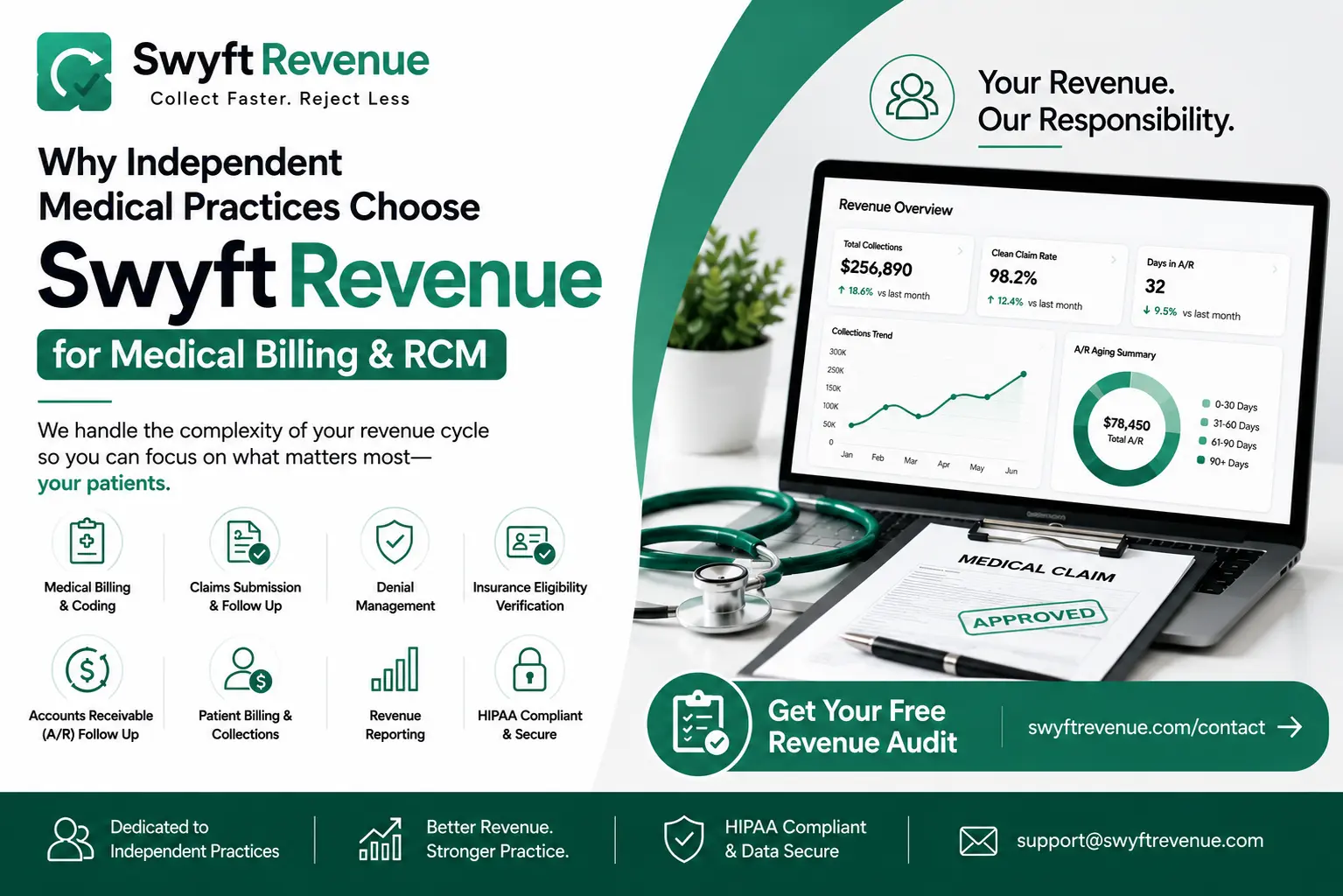
Swyft Revenue helps healthcare practices strengthen their medical billing and revenue cycle management processes, providing support for the financial workflows that keep revenue moving while practices evaluate their administrative needs.
How Does Prior Authorization Impact Medical Practice Cash Flow?
Prior authorization and revenue cycle management are closely connected, but they serve different purposes. Authorization determines whether a payer approves a service under its requirements; billing and revenue cycle management focus on submitting claims, managing payment issues, and tracking reimbursement.
When authorization requirements are missed, practices may experience scheduling disruptions, additional administrative work, or claim denials where authorization is required. Even after approval, payment is not guaranteed because claims must still meet applicable coverage, coding, documentation, and payer rules.
Common financial consequences include:
- Delayed reimbursement: Claims requiring correction or additional review can take longer to resolve.
- Increased denial workload: Staff may need to investigate authorization-related denials and coordinate appropriate corrections or appeals.
- Unresolved accounts receivable: Time spent addressing preventable issues can delay follow-up on other unpaid claims.
- Limited financial visibility: Inconsistent tracking makes it harder to identify recurring problems and prioritize outstanding revenue.
Swyft Revenue addresses key revenue cycle challenges through medical billing, denial management, accounts receivable follow-up, and payment reconciliation. These services help practices manage the financial side of authorization-related delays without confusing authorization approval with a guarantee of payment.
What Are the 2026 CMS Prior Authorization Decision Timeframes?
The CMS Interoperability and Prior Authorization Final Rule (CMS-0057-F) introduced important requirements for certain impacted payers beginning in 2026. For covered medical items and services, excluding drugs, these payers generally must issue decisions within:
- 7 calendar days for standard, non-urgent prior authorization requests.
- 72 hours for expedited, urgent prior authorization requests.
The requirements apply to specified payer programs, including Medicare Advantage and certain Medicaid and CHIP plans. The rule includes program-specific provisions and exceptions, so practices should verify which requirements apply to each payer and service. These are payer decision deadlines, not a guarantee that a provider’s request will be approved or that a claim will be paid.
The rule also requires impacted payers to provide a specific reason for denied prior authorization requests beginning in 2026. This can help providers understand the decision and determine whether additional documentation, resubmission, or an appeal may be appropriate.
For practice managers, understanding these requirements is an important part of operational planning. However, regulatory awareness alone does not resolve the day-to-day work of tracking requests, correcting claims, and managing outstanding payments.
How Can Practices Reduce Prior Authorization Workload and Denials?
Reducing administrative pressure starts with identifying where requests and billing tasks become stuck. Practices can review their existing processes by focusing on three areas:
1. Improve workflow visibility
Maintain clear records of request status, outstanding documentation, payer communications, and next actions. Where appropriate, use available technology to reduce manual tracking and repetitive data entry.
2. Investigate recurring denials
Review denial reasons to identify whether problems relate to missing authorization, incomplete documentation, coding, eligibility, or other claim requirements. Corrective action should address the actual cause rather than treating every denial in the same way.
3. Separate authorization tasks from billing follow-up
Authorization coordination and revenue cycle management overlap, but they are not interchangeable. Assigning clear responsibility for each process helps prevent unpaid claims from being overlooked while staff handle authorization requests.
Prior authorization workflow automation may reduce repetitive administrative steps when suitable tools are available. However, automation does not remove the need for accurate information, appropriate clinical review, payer-specific procedures, and human follow-up when a request requires intervention.
Why Independent Practices Consider Outsourced Prior Authorization and Billing
For independent practices, expanding the in-house team may not be the only way to address growing administrative demands. Additional employees bring recruitment, training, and ongoing staffing costs, while existing workflow problems may remain unresolved.
Practices exploring outsourced prior authorization and billing should assess exactly which activities a prospective partner performs. Prior authorization management for independent practices may include request preparation, submission, status tracking, and follow-up—but these services should never be assumed to be included in a medical billing agreement.
For practices experiencing authorization-related billing delays, this support can help address downstream revenue cycle issues while the practice evaluates how its authorization responsibilities should be managed.
How Swyft Revenue Medical Billing Services Support Your Practice
Medical billing and claim submission: Support for accurate claim preparation and submission helps practices address billing errors that can interfere with reimbursement.
Denial management: Review and follow-up help practices identify denial reasons and determine appropriate next steps, including corrections or appeals when warranted.
Accounts receivable recovery: Structured follow-up helps keep outstanding claims visible and ensures unresolved balances receive appropriate attention.
Payment posting and reconciliation: Accurate payment records help practices identify discrepancies between payer payments and expected reimbursement.
Revenue cycle reporting: Financial reporting gives practice leaders better insight into claim status, denial trends, and areas that need further investigation.
Together, these services support a more organized financial workflow, particularly for practices whose staff are balancing authorization-related administration with ongoing billing responsibilities.
If you are specifically looking for direct prior authorization submission, tracking, or follow-up, confirm that the prospective provider offers those services before engaging them. Swyft Revenue’s billing and denial management services should be matched to your practice’s actual requirements.
How Do You Stop Prior Authorization Claim Denials?
There is no single fix for every authorization-related denial. The appropriate response depends on the payer’s requirements and the specific reason for the denial.
Practices should verify authorization requirements before applicable services, maintain complete supporting documentation, track outstanding decisions, and review denial notices carefully. When a claim is denied, determine whether the issue calls for corrected information, resubmission, an appeal, or another action under the payer’s rules.
Swyft Revenue can support the billing side of this process. This gives practices a clearer way to address unresolved billing issues rather than allowing them to remain buried in a growing queue of administrative tasks.
Areas We Cover: All 50 States and Washington, D.C.
Our coverage includes California, Texas, Florida, New York, Pennsylvania, Illinois, Ohio, Georgia, North Carolina, Michigan, New Jersey, Virginia, Washington, Arizona, Massachusetts, Tennessee, Indiana, Missouri, Maryland, Wisconsin, Colorado, Minnesota, South Carolina, Alabama, Louisiana, Kentucky, Oregon, Oklahoma, Connecticut, Utah, Iowa, Nevada, Arkansas, Mississippi, Kansas, New Mexico, Nebraska, West Virginia, Idaho, Hawaii, New Hampshire, Maine, Montana, Rhode Island, Delaware, South Dakota, North Dakota, Alaska, Vermont, and Wyoming.
Give Your Team More Time to Focus on Patients
Prior authorization places a real demand on practice resources, but billing problems do not have to become another unmanaged burden. A clearer division of responsibilities and dependable revenue cycle support can help your organization maintain visibility over claims, denials, payments, and outstanding revenue.
Swyft Revenue helps medical practices strengthen their billing operations with dedicated revenue cycle management support.
If your practice is struggling with authorization-related claim delays, growing accounts receivable, or recurring denials, contact Swyft Revenue to discuss your current billing challenges and identify the services that best fit your needs.
SwyftRevenue — Your Revenue. Our Responsibility.
📧support@swyftrevenue.com
🌐SwyftRevenue.com/contact