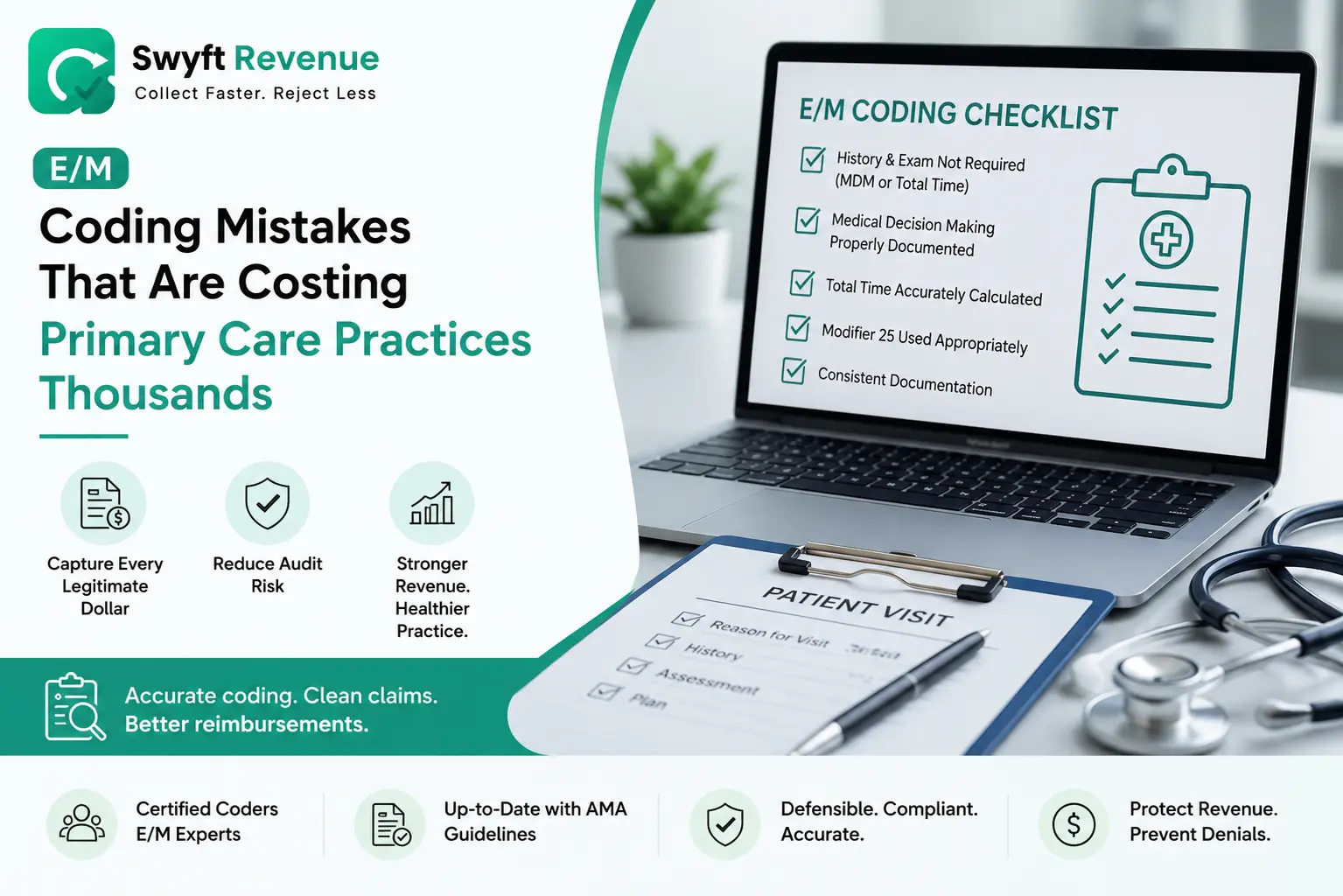
E/M Coding Mistakes That Are Costing Primary Care Practices Thousands
Aug 21, 2026
Evaluation & Management (E/M) coding is the backbone of primary care billing nearly every patient visit runs through it....
Read More →

Medical billing is no longer limited to paperwork, claim submissions, and payer phone calls.
Artificial intelligence (AI) and automation are changing how healthcare practices manage claims, identify errors, review denials, prioritize A/R, support coding, and monitor revenue cycle performance.
For small and independent medical practices, the opportunity is not to replace billing professionals with technology. It is to use technology to reduce repetitive work while allowing experienced professionals to focus on complex billing issues.
This creates a practical model for modern revenue cycle management:
AI + automation + human expertise.
What Is AI Medical Billing?
AI medical billing uses artificial intelligence, automation, and data analysis to support revenue cycle tasks.
Depending on the technology, AI can assist with:
The goal is simple: help billing teams work more efficiently and spend more time on accounts that require human attention.
How AI Is Changing Medical Billing
1. Claim Error Detection
AI powered systems can review claim information and identify potential issues before submission.
These may include missing information, coding inconsistencies, eligibility concerns, or other claim errors.
Finding problems earlier can help reduce avoidable rework and improve the overall billing workflow.
2. Denial Management
Denials can take significant time to resolve.
AI can help identify denial patterns and organize claims based on factors such as payer, procedure, denial reason, or previous claim activity.
However, technology is only part of the process.
A billing professional still needs to review complex denials, determine the appropriate response, communicate with payers, and follow claims through resolution.
3. A/R Prioritization
Not every outstanding account requires the same level of attention.
AI and automation can analyze information such as claim age, balance, payer, status, and previous activity to help billing teams prioritize their A/R workload.
This can make follow up more organized and help staff focus on accounts that need attention.
4. Eligibility Verification
Billing problems can begin before a claim is submitted.
Automated eligibility workflows can help practices verify insurance information earlier and identify potential coverage issues.
Addressing these problems before billing can reduce unnecessary claim corrections and follow up.
5. Coding Assistance
AI can support coding workflows by reviewing documentation and identifying potential coding information for professional review.
This can help reduce repetitive work, but human oversight remains important.
Medical coding requires attention to documentation, clinical circumstances, payer requirements, and applicable billing rules.
6. Prior Authorization
Prior authorization can create administrative work for small practices.
Technology can help organize information, identify requirements, and support electronic authorization workflows.
The purpose is not simply to automate authorization. It is to make the process easier to manage and track.
7. Revenue Cycle Reporting
AI can also help practices understand their billing data.
Revenue cycle technology can identify trends involving:
Better reporting can give practice managers a clearer picture of where revenue may be delayed.
Where Human Billing Expertise Still Matters
AI can process information quickly, but medical billing is not always predictable.
Some claims involve unusual circumstances, complex denials, documentation questions, payer specific requirements, or appeals.
These situations require professional judgment.
Experienced billing teams can:
That is why AI should be viewed as a billing support tool, not a complete replacement for experienced revenue cycle professionals.
What AI Means for Small Medical Practices
Large healthcare organizations may have extensive technology and internal RCM departments.
Small and independent practices often have fewer resources.
Staff may be responsible for billing, scheduling, eligibility, patient communication, documentation, and other administrative responsibilities at the same time.
Automation can help reduce some repetitive tasks and give staff more time to focus on higher value work.
For small practices, the goal should not be to adopt every new AI tool.
Instead, practices should ask:
These questions can help practices adopt technology based on actual business needs.
Should Small Practices Build AI In House?
Building a complete AI powered billing system internally can require significant technology, integration, security, and training resources.
For many small practices, using an experienced technology enabled RCM partner may be a more practical option.
This approach allows practices to benefit from automation while still having experienced billing professionals manage complex accounts.
The model is straightforward:
Technology handles repetitive tasks.
Billing professionals handle complex decisions.
The practice stays focused on patient care.
How Swyft Revenue Combines Technology With RCM Expertise
At Swyft Revenue, we believe technology works best when combined with experienced revenue cycle professionals.
Our approach focuses on using modern tools and organized workflows while maintaining the human expertise needed to manage complex billing situations.
Our revenue cycle support can include:
The goal is not simply to automate billing.
The goal is to create a more organized, visible, and efficient revenue cycle.
Who We Serve
Swyft Revenue supports U.S. healthcare practices that need professional billing and revenue cycle support, including:
Free Healthcare Revenue Audit
Not sure where your revenue cycle is losing time or money?
A healthcare revenue audit can help identify potential issues involving:
Swyft Revenue can help your practice understand where revenue may be getting delayed and where your billing process could be improved.
Request your Free Healthcare Revenue Audit today.
Frequently Asked Questions
Will AI replace medical billing professionals?
AI can automate and support repetitive billing tasks, but complex claims, denials, payer communication, and exceptions still require human expertise.
How can AI help small medical practices?
AI can help small practices identify billing errors, organize claims, prioritize A/R, support eligibility workflows, and analyze revenue cycle data.
What is AI revenue cycle management?
AI revenue cycle management combines artificial intelligence and automation with traditional RCM processes to improve efficiency across billing, claims, denials, A/R, and reporting.
Can AI reduce medical billing workload?
AI can reduce certain repetitive administrative tasks. The actual impact depends on the technology, workflow, implementation, and practice.
Should a practice outsource medical billing or use AI?
These options can work together. A technology enabled billing partner can provide automation while experienced professionals manage complex revenue cycle tasks.
Conclusion
AI is changing medical billing, but the future is not simply about replacing people with technology.
The real opportunity is to combine AI, automation, and human expertise.
For small and independent medical practices, this can mean fewer repetitive tasks, better visibility into A/R, more organized workflows, and more time for staff to focus on patients and practice operations.
Swyft Revenue combines modern technology with experienced revenue cycle support to help practices manage billing more efficiently.
Your Revenue. Our Responsibility.