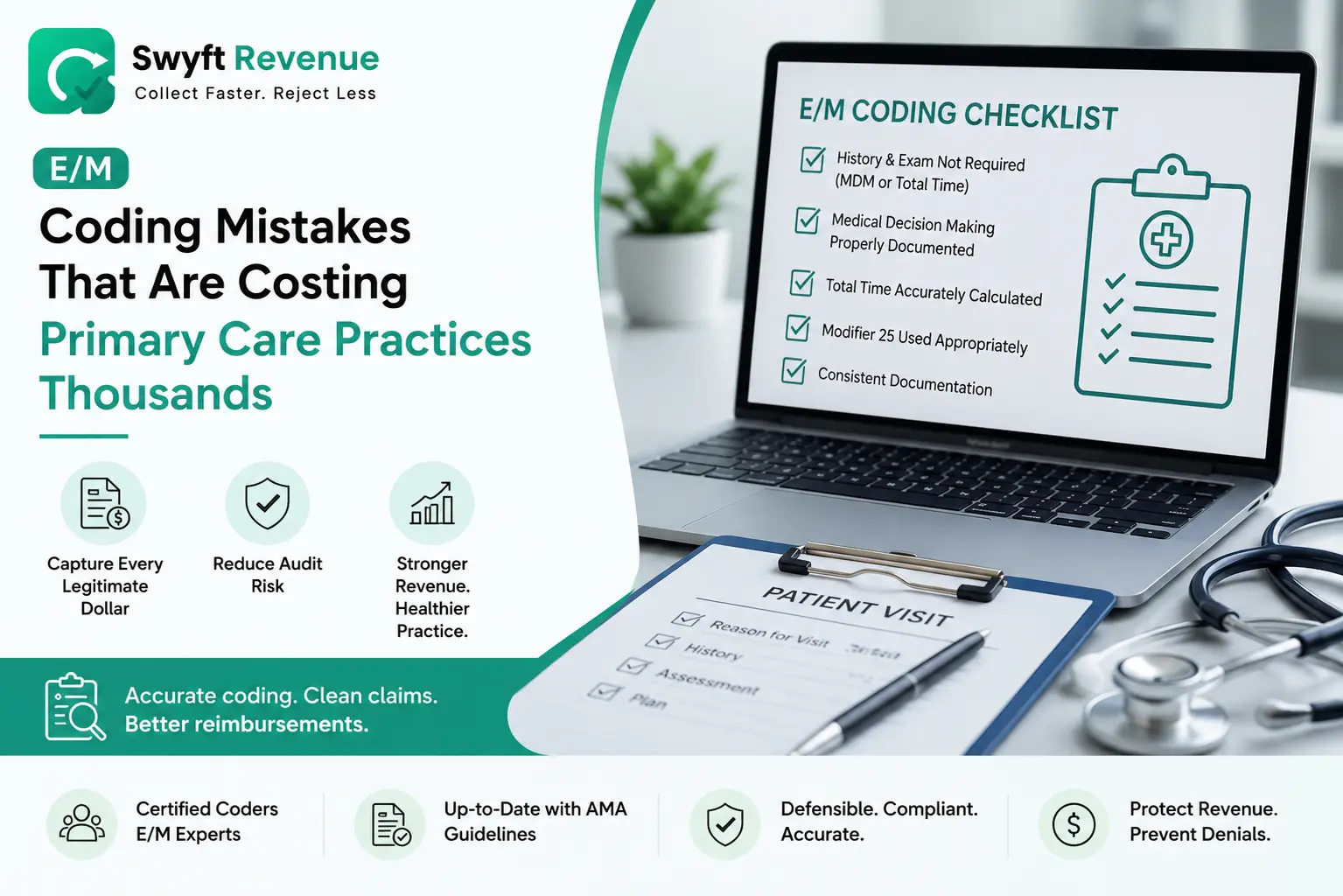
E/M Coding Mistakes That Are Costing Primary Care Practices Thousands
Aug 21, 2026
Evaluation & Management (E/M) coding is the backbone of primary care billing nearly every patient visit runs through it....
Read More →

Medical billing is becoming more complex for independent practices. Changing payer requirements, claim denials, prior authorization, rising administrative workloads, and aging A/R can all affect how quickly a practice gets paid.
At the same time, technology, automation, and specialized Revenue Cycle Management (RCM) are changing how practices manage their finances.
Understanding the 2026 medical billing trends can help practice owners identify problems earlier, improve cash flow, and prevent revenue from getting stuck in the billing cycle.
Here are the major medical billing trends independent practices should watch in 2026 and what they mean for your practice.
AI and Automation Are Changing Medical Billing
One of the most important trends in healthcare revenue cycle management 2026 is the growing use of artificial intelligence and automation.
AI in medical billing 2026 is increasingly being applied to repetitive administrative processes such as coding assistance, claim processing, denial identification, eligibility verification, and reporting.
For independent practices, the goal should not be adopting technology simply because it is new. The focus should be on finding processes where technology can reduce repetitive work while maintaining accuracy and human oversight.
Automation in revenue cycle management can support:
Technology can make billing more efficient, but experienced billing professionals are still important for reviewing exceptions, resolving complex claims, and making appropriate decisions.
Denial Management Is Becoming More Important
Claim denials represent revenue that a practice has earned but has not yet collected.
Every denied claim may require someone to review the payer's reason, correct information, submit documentation, file an appeal, and follow up until the claim is resolved.
The bigger problem is recurring denials.
Practices asking how to reduce claim denials in medical practice should look beyond individual claims and identify patterns.
Important areas to monitor include:
Professional denial management RCM support can help practices identify recurring problems while ensuring denied claims receive consistent follow-up.
Prior Authorization Requires Better Workflows
Prior authorization continues to create administrative pressure for medical practices.
Requirements can vary between insurance companies, plans, procedures, and services. Missing or incomplete authorization information can contribute to treatment delays, claim denials, and additional administrative work.
A structured prior authorization workflow solution should include:
Practices can also benefit from a digital prior authorization workflow that makes it easier to track requests and required documentation.
For smaller practices, outsourcing administrative components of this process can reduce the workload on internal staff.
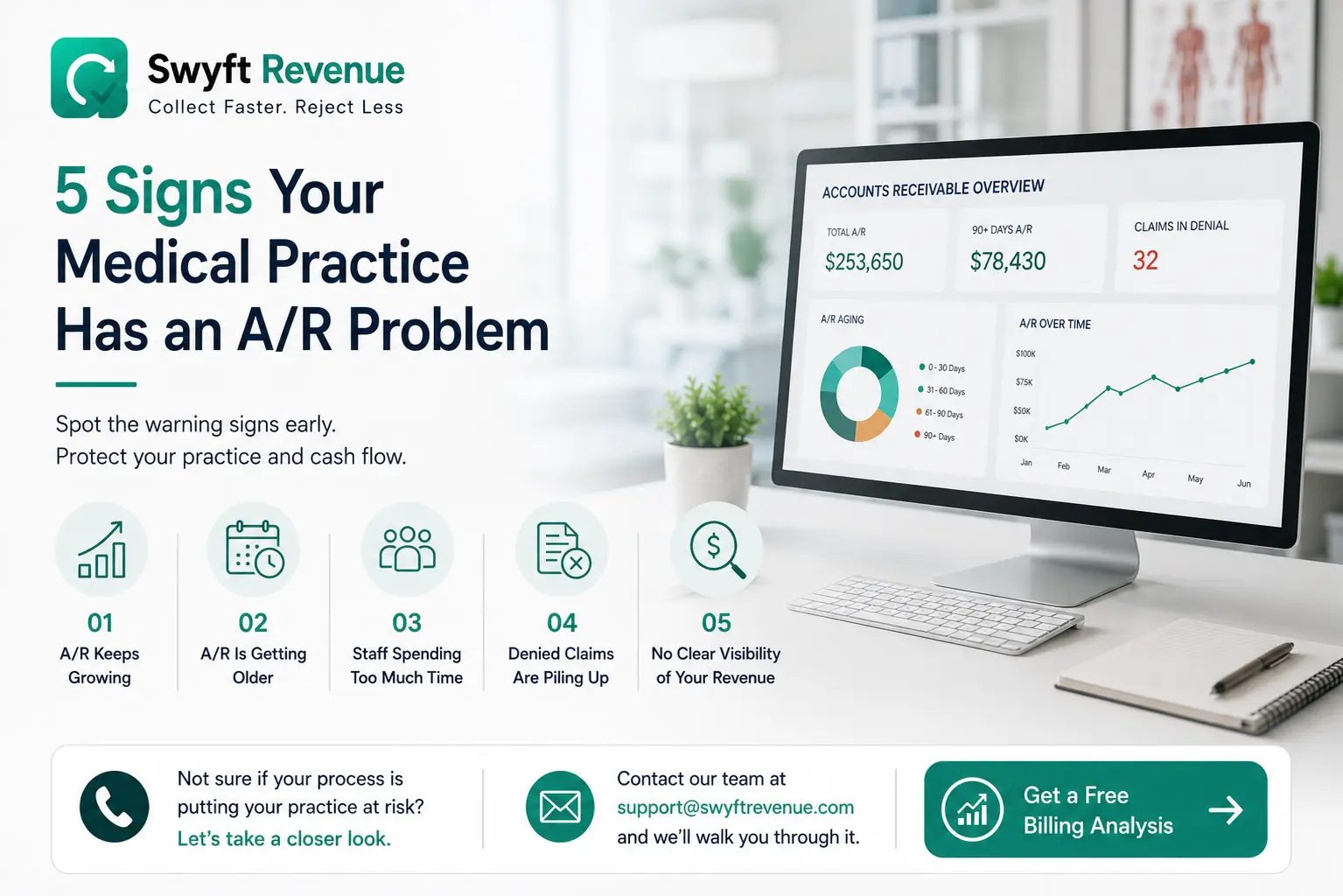
A/R Follow-Up Is Critical to Cash Flow
Submitting a claim does not mean the revenue cycle is complete.
Claims can remain unpaid because of denials, payer delays, missing information, authorization issues, or requests for additional documentation.
Without consistent follow-up, unpaid balances can move from 30 to 60, 90, or 120+ days.
This makes aging A/R recovery for medical practices an important part of financial management.
Effective accounts receivable management in healthcare should monitor:
The objective is not simply to know how much money is outstanding. It is to actively work those accounts and determine why revenue is delayed.
Revenue Visibility Is Becoming Essential
Practice owners need more than a total A/R figure to understand their financial performance.
They should be able to answer:
Which payers owe us the most?
How much A/R is over 90 days?
What are our most common denial reasons?
How quickly are claims being paid?
Where is revenue getting stuck?
Revenue cycle analytics reporting can provide better visibility into claims, collections, denials, and outstanding balances.
Better reporting can also help practices identify revenue leakage in medical billing before small problems become larger financial issues.
Independent Practices Are Looking for More Efficient Billing Models
Large healthcare organizations may have separate departments for coding, billing, denials, A/R, credentialing, and reporting.
Independent practices often have much smaller teams.
One employee may be responsible for eligibility, patient calls, claims, payment posting, and follow-up.
As administrative requirements increase, this model can become difficult to maintain.
This is why revenue cycle management for independent practices is increasingly focused on efficiency, technology, and access to specialized billing expertise.
For some practices, improving internal processes may be enough. For others, outsourcing medical billing vs in-house becomes an important business decision.
Outsourced RCM Is Becoming a Strategic Option
Outsourced RCM for independent practices can provide access to specialized billing expertise without requiring a practice to build a large internal revenue cycle department.
A professional RCM partner can support areas such as:
For smaller practices, RCM services for small practices can provide additional support while allowing clinical and administrative staff to focus on their primary responsibilities.
The goal is not simply to outsource work. It is to create a more consistent revenue cycle with better accountability and visibility.
What These 2026 Trends Mean for Your Practice
The major change in medical billing is not one individual technology or payer policy.
It is the increasing complexity of the entire revenue cycle.
Eligibility affects claims. Authorization affects reimbursement. Coding affects claim acceptance. Denials affect A/R. A/R affects cash flow.
That means practices need to manage billing as a complete revenue cycle rather than treating each issue separately.
How Swyft Revenue Helps Independent Practices
Swyft Revenue medical billing services are designed to help independent and small healthcare practices manage the challenges of today's revenue cycle.
Our team can support your practice with:
Medical Billing & Coding
Our medical billing and coding services help practices manage claims accurately and address billing issues that may affect reimbursement.
Claims Submission & Follow-Up
Our team handles medical claims submission and follow up, helping ensure outstanding claims receive consistent attention instead of sitting unresolved.
Denial Management
With denial management RCM support, we review denial reasons, work on appropriate corrections and appeals, and identify recurring issues affecting your revenue.
Insurance Eligibility Verification
Our insurance eligibility verification services help identify coverage issues earlier and reduce avoidable billing problems.
A/R Management
Our accounts receivable management healthcare support focuses on outstanding balances and aging accounts that require continued follow-up.
Revenue Reporting
Through revenue cycle analytics reporting, practices can gain better visibility into claims, collections, denials, and A/R performance.
How Does Swyft Revenue Help?
Swyft Revenue combines billing expertise, technology, and dedicated RCM support to help practices manage the financial side of healthcare.
Instead of expecting a small internal team to manage every billing function, practices can access specialized support for claims, denials, A/R, eligibility, and reporting.
The objective is straightforward: help practices collect more of the revenue they have already earned while reducing unnecessary administrative pressure.
How to Improve Cash Flow for an Independent Medical Practice
Improving cash flow does not always require seeing more patients.
It can start with improving the revenue already being generated.
Practices should regularly review:
A detailed billing review can reveal where money is being delayed or lost.
Frequently Asked Questions
What are the key medical billing trends in 2026?
The major trends include AI and automation, stronger denial management, digital prior authorization, improved A/R follow-up, revenue analytics, and increased use of outsourced RCM services.
Why should independent practices outsource RCM?
Outsourcing can give independent practices access to specialized billing expertise without maintaining a large in-house billing department. It can also provide additional support for claims, denials, A/R, eligibility, and reporting.
How does Swyft Revenue help independent practices?
Swyft Revenue supports independent practices with medical billing and coding, claims submission and follow-up, denial management, eligibility verification, A/R management, and revenue reporting.
How can an independent medical practice improve cash flow?
Practices can improve cash flow by strengthening eligibility and authorization processes, reducing avoidable denials, following up on unpaid claims, managing aging A/R, and identifying revenue leakage.
When should a practice consider outsourced RCM?
A practice may consider outsourced RCM when internal staff are struggling with growing A/R, recurring denials, delayed claims, administrative workload, or limited visibility into billing performance.
Get a Free Medical Practice Billing Audit
If your practice is experiencing growing A/R, frequent denials, delayed payments, authorization issues, or increasing billing workload, it may be time to examine your revenue cycle.
Swyft Revenue can review your billing and A/R performance, identify potential revenue cycle gaps, and help you understand where claims or unpaid balances may be affecting your cash flow.
Want to identify potential problems in your revenue cycle?
Request a medical practice billing audit free from Swyft Revenue.
📧 support@swyftrevenue.com
🌐 SwyftRevenue.com/contact