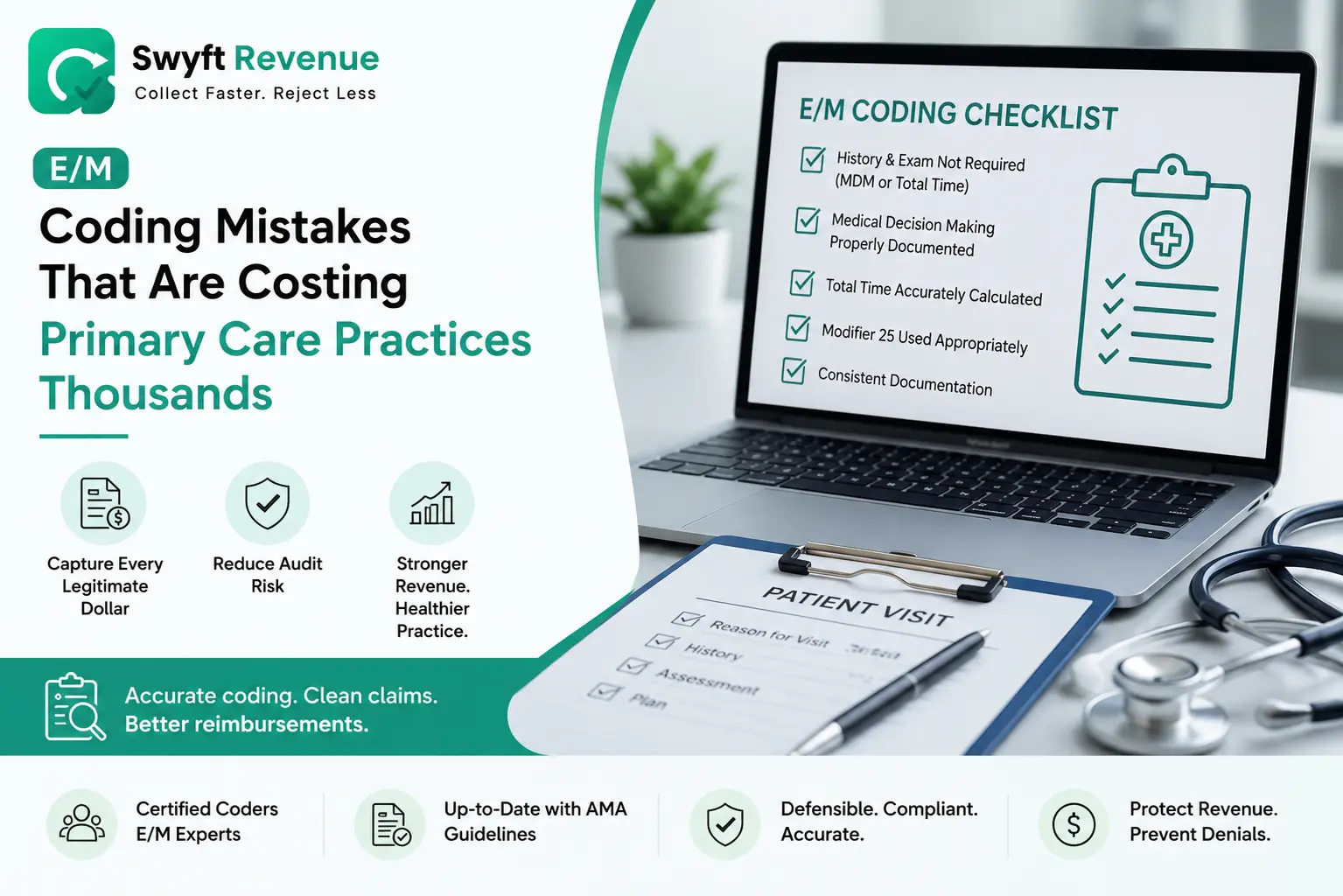
E/M Coding Mistakes That Are Costing Primary Care Practices Thousands
Aug 21, 2026
Evaluation & Management (E/M) coding is the backbone of primary care billing nearly every patient visit runs through it....
Read More →

Telehealth is an important part of care for many Rural Health Clinics (RHCs) and Federally Qualified Health Centers (FQHCs). But RHC telehealth billing 2026 requirements are changing, making accurate billing and revenue cycle management more important.
Beginning October 1, 2026, applicable RHC and FQHC distant-site telehealth services will generally move away from reporting G2025. Instead, organizations will report the individual CPT or HCPCS code describing the service, along with the appropriate telehealth modifier.
For practices already managing claims, denials, and A/R, these changes can create additional administrative work.
This is where Swyft Revenue helps.
Why RHC & FQHC Telehealth Billing Is Becoming More Complex
The FQHC telehealth changes 2026 requirements add another layer to an already detailed billing process.
Healthcare organizations need to pay attention to:
One billing issue may seem minor. But when multiple claims are affected, the administrative workload can quickly grow.
Swyft Revenue provides the billing support your organization needs to manage these responsibilities.
What Is Changing With G2025 Telehealth Billing?
One of the most important changes involves G2025 telehealth billing.
For applicable non-behavioral-health distant-site telehealth services, G2025 remains part of the billing process through September 30, 2026.
Beginning October 1, 2026, RHCs and FQHCs will generally report the individual CPT or HCPCS code describing the telehealth service.
This makes replacing G2025 with CPT codes an important part of preparing for the new requirements.
Accurate code selection and claim submission will be essential.
Swyft Revenue can handle the billing process for you.
RHC Telehealth Modifiers 93 and 95
The RHC telehealth modifiers 93 and 95 identify how a synchronous telehealth service is delivered.
Modifier 93
Modifier 93 is used for synchronous telemedicine delivered through real-time interactive audio-only telecommunications.
Modifier 95
Modifier 95 is used for synchronous telemedicine delivered through real-time interactive audio and video telecommunications.
Correct code and modifier reporting is an important part of accurate claim submission.
Swyft Revenue healthcare billing support helps your organization manage these billing details while keeping your revenue cycle moving.
October 2026 CMS Telehealth Billing Changes
The October 2026 CMS telehealth billing changes mean RHCs and FQHCs need to prepare their billing operations before the new requirements take effect.
Your billing process may need to account for:
Submitting the claim is only the beginning.
The goal is to move the claim through the revenue cycle toward payment.
That's where Swyft Revenue comes in.
When RHC & FQHC A/R Starts Growing
One unresolved claim may not seem significant. But when dozens or hundreds of claims remain outstanding, the impact can become much more noticeable.
Growing telehealth A/R can contribute to:
This is why effective FQHC revenue cycle management is so important.
Swyft Revenue provides dedicated A/R follow-up and revenue cycle support to help manage outstanding claims.
RHC Denied Telehealth Claims Need Attention
RHC denied telehealth claims require more than simply identifying that a claim was denied.
The account may need to be reviewed to determine:
When denied claims accumulate, internal billing staff can quickly become overwhelmed.
Swyft Revenue provides denial management and A/R support to help healthcare organizations manage unresolved claims.
The Solution: Swyft Revenue
Instead of making physicians, practice managers, or internal office staff responsible for every billing issue, healthcare organizations can work with a specialized billing partner.
Swyft Revenue provides outsourced RHC billing services and FQHC revenue cycle management for healthcare organizations that need dedicated billing support.
Our team manages the billing work so your staff can focus on healthcare operations and patient care.
Our Team Can Support Your Practice With
RHC & FQHC Medical Billing
Swyft Revenue provides professional medical billing support and manages billing throughout the revenue cycle.
Telehealth Claims Submission & Follow Up
Submitting a claim is only the beginning. Our team provides continued attention to outstanding claims and billing accounts.
FQHC Denial Management
Our FQHC denial management support focuses on reviewing denied claims and managing appropriate billing follow-up.
A/R Follow Up
Outstanding balances need continued attention. Our team works on unresolved accounts and claims requiring additional billing work.
Medicare Medical Billing
We support healthcare organizations with Medicare billing and broader revenue cycle management.
FQHC Revenue Cycle Management
Our FQHC revenue cycle management support focuses on the movement of revenue through billing, claims, denials, A/R, and reimbursement.
Why Practices Choose Swyft Revenue
Partnering with a billing company isn't simply about transferring administrative work. It's about having a dedicated team focused on your revenue cycle.
With Swyft Revenue, healthcare organizations receive:
Reduced Administrative Pressure
Your internal staff can spend less time managing billing issues and unresolved claims.
Dedicated A/R Support
Outstanding balances receive continued attention instead of simply remaining on an aging report.
Denial Management Support
Denied claims become part of an organized billing follow-up process.
Revenue Cycle Support
Our team focuses on the broader revenue cycle instead of treating every claim as an isolated transaction.
Specialized Healthcare Billing
RHC and FQHC billing involves specific requirements. Swyft Revenue provides dedicated support for these responsibilities.
Who Can Benefit From RHC & FQHC Billing Services?
Swyft Revenue can support:
If your team is spending too much time managing claims and billing instead of running the practice, Swyft Revenue can handle the billing workload.
The FQHC Distant-Site Telehealth Payment Rate
For calendar year 2026, the FQHC distant-site telehealth payment rate is $97.53 for applicable services.
Understanding the payment rate is important, but reimbursement also depends on accurate billing and effective claim management.
A claim that is submitted incorrectly or remains unresolved can create additional delays.
Swyft Revenue helps manage your billing process beyond initial claim submission.
How Swyft Revenue Supports Your Revenue Cycle
Swyft Revenue provides comprehensive medical billing and revenue cycle management support for U.S. healthcare providers.
Our services include:
You provide the care.
We focus on the revenue cycle behind it.
FAQs
What are the RHC telehealth billing changes for 2026?
Beginning October 1, 2026, applicable RHC distant-site telehealth services will generally move from G2025 reporting to individual CPT/HCPCS reporting with the appropriate modifier.
What are the FQHC telehealth changes in 2026?
FQHCs will also need to follow the applicable individual CPT/HCPCS reporting requirements for distant-site telehealth services beginning October 1, 2026.
What is replacing G2025?
For applicable services, RHCs and FQHCs will generally report the individual CPT or HCPCS code describing the telehealth service instead of G2025.
What are telehealth modifiers 93 and 95?
Modifier 93 applies to synchronous audio-only telemedicine, while modifier 95 applies to synchronous audio and video telemedicine.
What is the 2026 FQHC distant-site telehealth payment rate?
The CY 2026 payment rate for applicable RHC/FQHC distant-site telehealth services is $97.53.
What are outsourced RHC billing services?
Outsourced RHC billing services involve using an external medical billing company to support claims, denials, A/R, and revenue cycle management.
Does Swyft Revenue provide FQHC billing services?
Yes. Swyft Revenue provides FQHC medical billing, claims follow-up, denial management, A/R recovery, and broader revenue cycle management support.
Conclusion
The RHC telehealth billing 2026 changes and FQHC telehealth changes 2026 create important billing considerations for healthcare organizations.
The transition away from G2025 for applicable services, individual CPT/HCPCS reporting, telehealth modifiers, and continued claim follow-up all make effective revenue cycle management increasingly important.
Your physicians and staff shouldn't have to spend their day managing unresolved claims and billing problems.
Let Swyft Revenue handle your RHC and FQHC billing.
From telehealth billing and Medicare claims to denial management, A/R recovery, and complete revenue cycle management, our team is focused on the billing behind your care.
Swyft Revenue — Your Revenue. Our Responsibility.
📧 support@swyftrevenue.com
🌐 SwyftRevenue.com/contact