Could Your Billing Data Trigger a Closer Review?
Your practice submits hundreds of claims every month. Most are processed routinely, but what if a pattern of high-level E/M codes, questionable modifier use, or unexplained payment differences attracts additional scrutiny?
Medical billing compliance audits help healthcare organizations identify potential billing errors, assess documentation practices, and address weaknesses before they become larger problems.
In 2026, practices also need to understand how data analytics and automated claim edits can help payers identify unusual billing patterns. A flagged claim does not automatically mean a violation has occurred, but it can lead to requests for supporting records or further review.
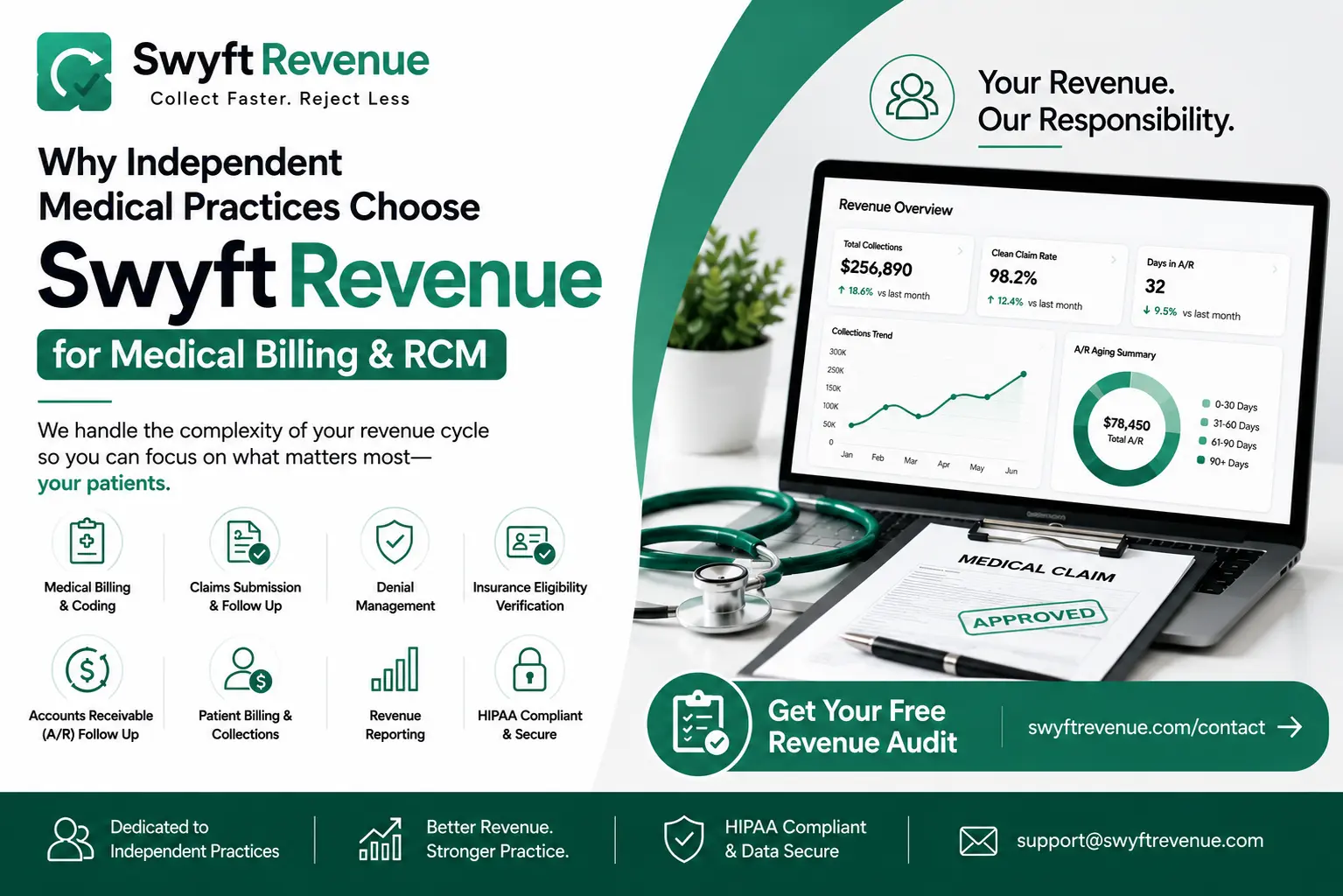
Swyft Revenue helps healthcare practices manage medical billing, denial management, accounts receivable (A/R) recovery, payment reconciliation, and reporting. Our services support the billing workflows practices rely on to maintain accurate records and investigate unresolved issues.
What Do Medical Billing Compliance Audits Check?
A medical practice compliance audit evaluates whether claims are supported by appropriate documentation and follow applicable coding, coverage, and payer requirements.
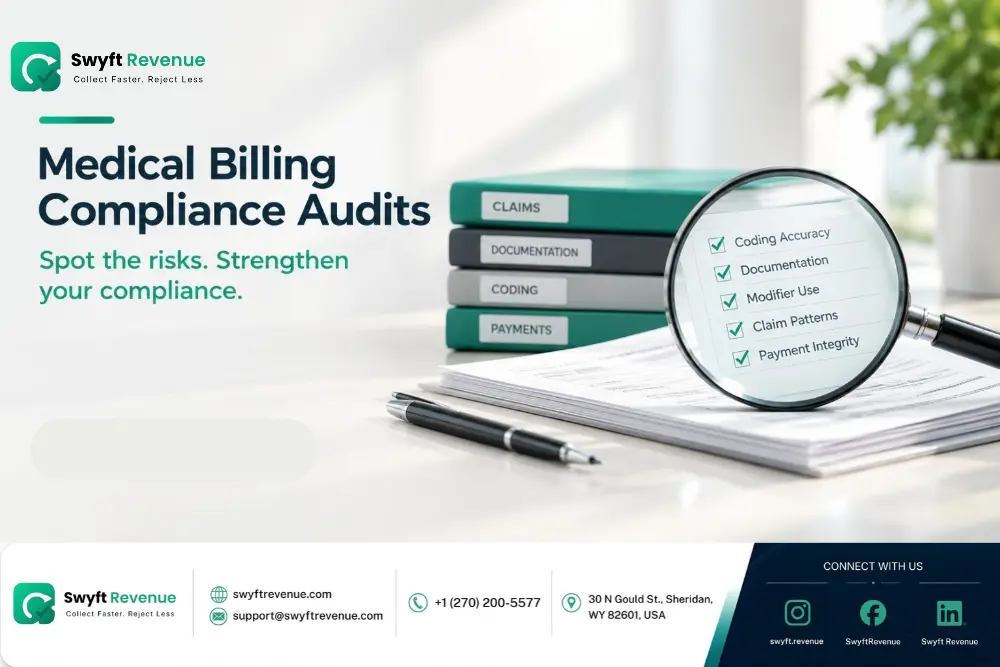
Typical review areas include:
- Medical coding compliance audit: Whether CPT and ICD-10-CM codes accurately reflect documented services.
- Documentation and medical necessity: Whether the medical record supports the service billed.
- Modifier accuracy: Whether modifiers are appropriate for the circumstances and payer rules.
- Claim patterns: Whether billing data reveals unusual trends requiring investigation.
- Payment accuracy: Whether payments, adjustments, and outstanding balances are recorded correctly.
The Office of Inspector General (OIG) recommends internal monitoring and auditing, written compliance standards, staff education, and corrective action as components of an effective compliance program. Its guidance can help practices develop a risk-based approach suited to their operations.
2026 Audit Risks: E/M Levels, Modifier 25, and Automated Reviews
Payer reviews can use claims analysis, coding edits, and other information to identify potential payment vulnerabilities. Practices should pay particular attention to billing patterns that are difficult to support consistently.
E/M Level 4 and 5 Outlier Audit Triggers
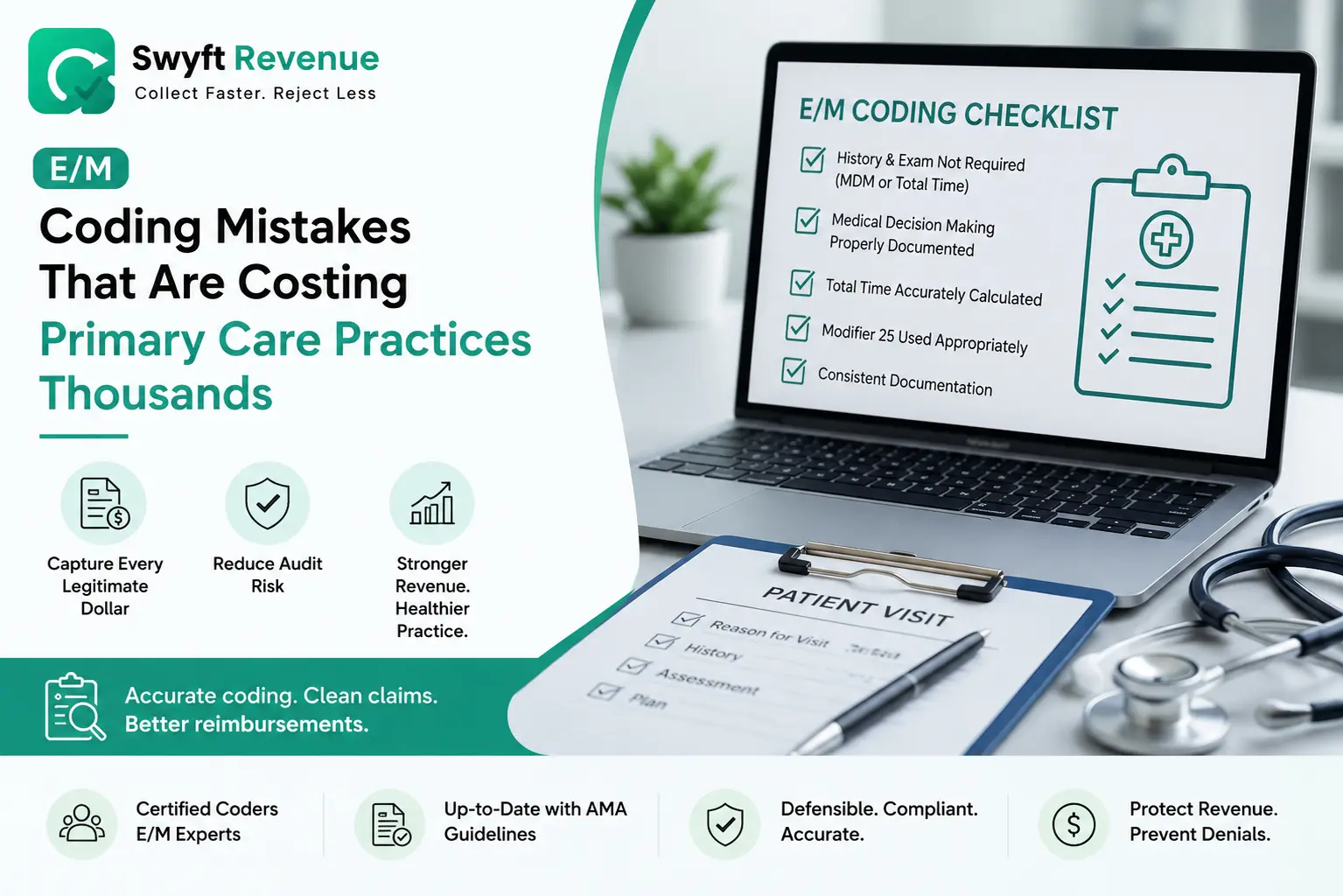
A high proportion of Level 4 and Level 5 evaluation and management (E/M) visits may attract questions when the pattern differs significantly from comparable practice activity or lacks appropriate supporting documentation.
The code level must reflect the requirements for the service documented, including applicable medical decision-making or time-based criteria. A high-level code is not inherently incorrect, and an outlier alone does not establish noncompliance.
Practices should review selected claims to confirm that documentation supports the billed level and investigate unexplained differences between providers or service types.
Modifier 25 Audit Risk Compliance
Modifier 25 indicates a significant, separately identifiable E/M service on the same day as another service or procedure when the applicable requirements are met.
Problems can arise when the documentation only reflects the routine work associated with the procedure, rather than a separately identifiable E/M service. Practices should review modifier use against the relevant CPT guidance and payer policies rather than applying it automatically.
AI Automated Payer Audit Algorithms in 2026
Automated claims analytics can help identify unusual code combinations, repeated billing patterns, duplicate claims, and other potential payment concerns. These systems can support claim screening, but a flag is not proof of an error or fraud.
For practices, the practical response is to review the claim, verify the supporting documentation, and resolve legitimate discrepancies before submission where possible. When a payer requests records or initiates a review, respond according to its instructions and deadlines.
How Often Should a Medical Practice Perform Billing Audits?
There is no single audit frequency that fits every practice. A sensible schedule depends on claim volume, specialty, previous findings, payer mix, staffing, and the level of risk identified.
A practical starting framework is:
- Monthly: Review recurring denials, unusual coding patterns, and newly identified billing risks.
- Quarterly: Conduct a more structured sample-based review and assess whether corrective actions are working.
- After a significant change: Review relevant claims after changes to coding guidance, billing workflows, software, or payer requirements.
- Immediately when warranted: Investigate credible concerns, significant discrepancies, or specific payer requests without waiting for the next scheduled review.
These intervals are a suggested operational framework, not a universal OIG requirement. Practices should set their schedule according to their own risk assessment and applicable obligations.
A Practical 20–30 Claim Billing Audit Protocol
For a smaller practice, a focused review of 20–30 claims can be a useful starting point for identifying potential issues. It is not a statistically representative sample in every situation and should not be treated as proof that all billing is compliant.
A practical protocol:
- Select claims by risk. Include claims associated with recurring denials, high-risk codes, modifier concerns, or unusual billing patterns.
- Compare codes with documentation. Verify the service, diagnosis, code level, and modifier against the record and applicable rules.
- Check payer requirements. Review relevant coverage policies, edits, and reimbursement rules.
- Record each finding. Separate confirmed errors from questions that require further review.
- Correct the underlying process. Determine whether staff education, workflow changes, or additional investigation is needed.
- Recheck the affected area. Follow up to see whether the same problem continues.
A qualified compliance professional may recommend a larger or differently structured sample when the risk, scope, or seriousness of the issue requires it.
What Triggers a Payer Medical Billing Audit in 2026?
There is no single universal trigger, and payers do not necessarily disclose every factor used in their review systems. Potential reasons for closer examination can include:
- Billing patterns that differ substantially from relevant peers.
- Repeated coding or modifier errors.
- Claims that fail applicable edits or coverage requirements.
- Documentation that does not support the billed service.
- Data analysis indicating a potential payment vulnerability.
- Previous review findings or unresolved documentation requests.
CMS explains that Medicare medical reviews may use claims analysis and other findings to identify potential vulnerabilities. Reviews can occur before or after payment, depending on the circumstances
These indicators are reasons to examine the relevant claims not evidence that a practice has committed a violation.
Contracted Fee Schedule Underpayment Audits: Are You Being Paid Correctly?
Compliance is not only about avoiding overpayments. Practices should also understand whether reimbursements match their contracted rates and the applicable terms.
A contracted fee schedule underpayment audit compares expected reimbursement with actual payments, taking into account contractual adjustments, claim details, and relevant payer rules.
Differences may arise from incorrect fee schedules, processing errors, inaccurate adjustments, or other contract-specific issues. Identifying them requires reviewing remittance advice, payment records, and the applicable agreement.
Swyft Revenue's payment posting, reconciliation, and A/R recovery services can support the review of payment discrepancies and unresolved balances. Contract interpretation and disputed reimbursement matters may require additional specialist support.
What Happens When a Billing Audit Finds an Error?
The response depends on the type of error, the payer, and the applicable requirements. Possible next steps include correcting a claim, providing additional documentation, investigating related claims, or assessing whether repayment or further reporting is necessary.
Practices should avoid assuming that every error is fraud or that every correction resolves all obligations. Potential overpayments and suspected compliance violations may require prompt guidance from qualified compliance or legal professionals.
A documented corrective-action process helps the practice establish what happened, determine the scope, and reduce the chance of recurrence.
How Swyft Revenue Supports Medical Billing Compliance Workflows
When internal teams are occupied with daily claims and follow-ups, it can be difficult to maintain visibility over recurring billing issues. Swyft Revenue supports healthcare practices with services designed to manage essential revenue cycle functions.
Medical Billing and Claim Submission
Swyft Revenue supports claim preparation and submission workflows, helping practices manage routine billing responsibilities and address issues that can lead to rework.
Medical Billing Denial and Compliance Recovery
Denials may reveal recurring problems with coding, documentation, eligibility, or payer requirements. Swyft Revenue helps practices review denial reasons and identify appropriate next steps, including corrections or appeals where warranted.
A/R Recovery and Payment Reconciliation
Outstanding claims and unexplained payment differences require follow-up. Swyft Revenue supports A/R recovery, payment posting, and reconciliation to help practices manage unresolved balances and identify discrepancies requiring investigation.
Revenue Cycle Reporting
Reports on claim status, denials, and receivables can help practice leaders identify patterns that need attention and make more informed workflow decisions.
Swyft Revenue serves healthcare practices across all 50 U.S. states and Washington, D.C.
Our coverage includes California, Texas, Florida, New York, Pennsylvania, Illinois, Ohio, Georgia, North Carolina, Michigan, New Jersey, Virginia, Washington, Arizona, Massachusetts, Tennessee, Indiana, Missouri, Maryland, Wisconsin, Colorado, Minnesota, South Carolina, Alabama, Louisiana, Kentucky, Oregon, Oklahoma, Connecticut, Utah, Iowa, Nevada, Arkansas, Mississippi, Kansas, New Mexico, Nebraska, West Virginia, Idaho, Hawaii, New Hampshire, Maine, Montana, Rhode Island, Delaware, South Dakota, North Dakota, Alaska, Vermont, and Wyoming.
Outsourced Medical Billing Compliance Audit: What Should You Look For?
If your internal team lacks the time or resources to review claims consistently, outsourcing selected billing functions may be worth considering. However, choosing a provider requires clarity about the scope of support.
Ask prospective providers:
- Can they support claim reviews and explain recurring billing issues?
- What processes cover denials, payment discrepancies, and A/R follow-up?
- What reporting will your practice receive?
- How are sensitive records accessed and handled?
- Do they offer formal compliance audits, or only routine billing and revenue cycle services?
For pre-payment audit defense for medical practices, confirm whether the provider can support the specific documentation and claim-management tasks you need. If a payer has already requested records, follow the official instructions and deadlines, and involve qualified compliance or legal professionals when appropriate.
No billing company can guarantee that a practice will avoid Medicare billing audit penalties. The objective is to maintain accurate claims, investigate problems promptly, and respond appropriately to identified risks.
Is Your Practice Ready for Its Next Audit?
If your team struggles with recurring denials, unexplained payment differences, or limited visibility into billing patterns, your current workflows may need closer attention.
Swyft Revenue can discuss your revenue cycle challenges and help determine whether its medical billing, denial management, A/R recovery, reconciliation, and reporting services fit your practice's needs.
Contact Swyft Revenue to discuss your billing challenges and explore practical revenue cycle support for your organization.
Swyft Revenue — Your Revenue. Our Responsibility.
📧 support@swyftrevenue.com
🌐 SwyftRevenue.com/contact