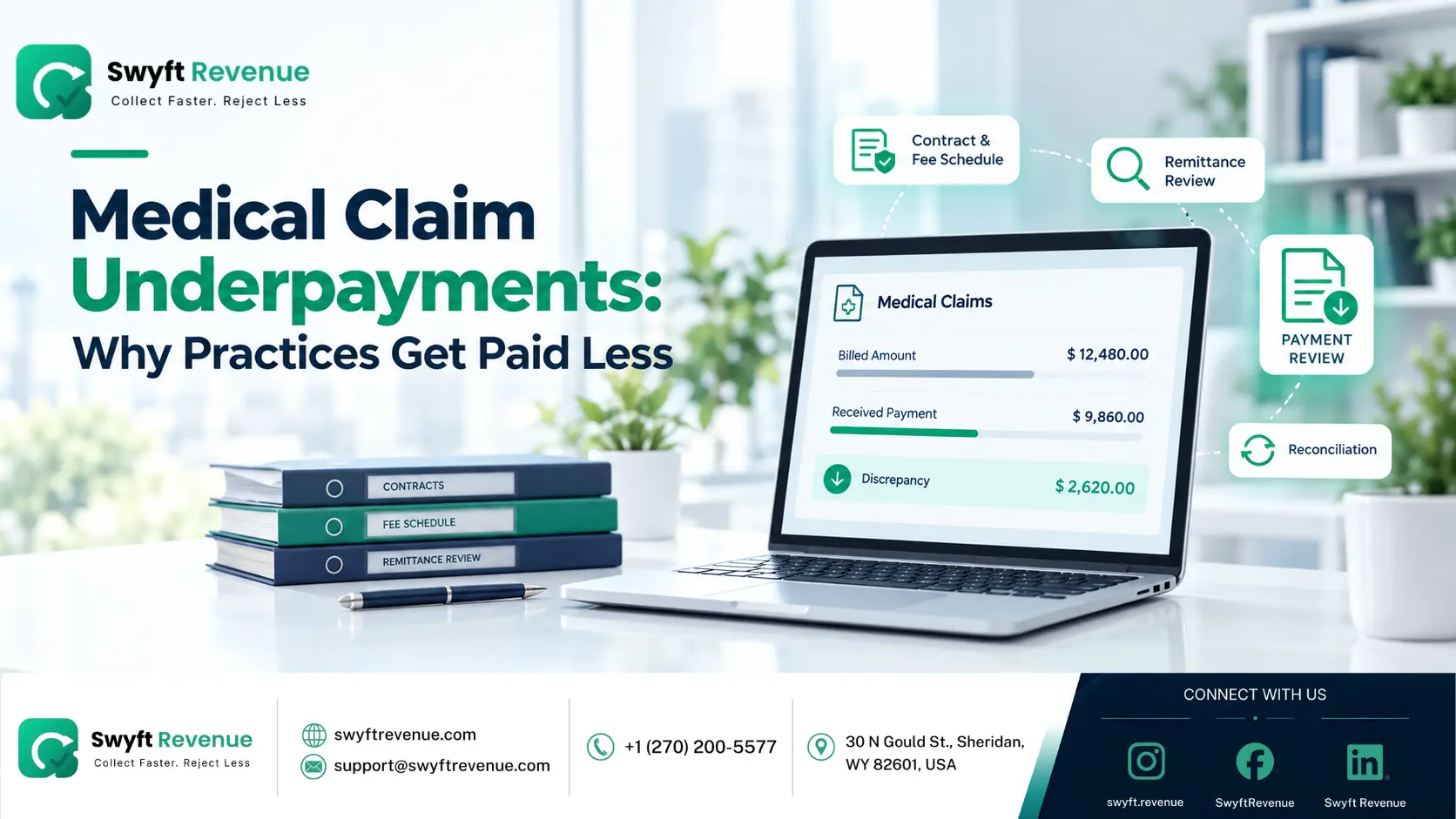
A claim marked as paid does not necessarily mean your practice has received the correct reimbursement. When insurers pay less than the amount owed under applicable contract terms, the difference can go unnoticed, especially when billing teams handle hundreds of claims.
These medical claim underpayments can create persistent healthcare reimbursement issues, reduce cash flow, and make financial performance harder to evaluate. The challenge is not simply finding payment differences; it is determining which discrepancies are valid, which require action, and how to address them consistently.
Swyft Revenue helps healthcare practices strengthen medical billing and revenue cycle workflows, with support for payment reconciliation, accounts receivable oversight, and payer follow-up. A structured process helps practices investigate payment discrepancies and improve visibility into reimbursement.
What Is a Medical Claim Underpayment?
A medical claim underpayment occurs when an insurer pays less than the amount properly due under the applicable payer agreement, reimbursement rules, and claim circumstances.
The billed amount is not necessarily what the insurer owes. Contracted rates, patient responsibility, coding, and payer policies all influence the expected payment.
For example, if the expected insurer payment is $150 but the payer sends $130 without a valid explanation, the $20 difference may require investigation. The practice must first verify the contract, claim details, and remittance information before treating it as recoverable revenue.
Why Do Payment Discrepancies Go Unnoticed in Medical Practices?
Payment discrepancies often remain unresolved because payment posting, adjustment review, and payer follow-up are handled as separate tasks. Common contributing factors include:
- Unverified write-offs: Differences are recorded as contractual adjustments without confirming their accuracy.
- Fee schedule errors: Outdated rates or incorrect system settings create a fee schedule variance in medical billing.
- Inconsistent reconciliation: Payment records are not routinely compared with expected reimbursement.
- Limited follow-up capacity: Staff may prioritize new claims and daily billing tasks over investigating older discrepancies.
- Incomplete tracking: Payment questions remain unresolved because ownership, deadlines, or payer responses are not monitored consistently.
Identifying these problems requires more than checking whether a claim has been paid. Practices need a repeatable review process that connects payment records with supporting documentation and applicable contract terms.
Contractual Adjustment vs. Underpayment: What Is the Difference?
Understanding contractual adjustment vs underpayment is essential before attempting to recover additional reimbursement.
A contractual adjustment generally represents the difference between the provider's billed charge and the allowed amount under the payer agreement. Patient responsibility, including deductibles, copayments, and coinsurance, may affect the final balance.
An underpayment occurs when the insurer pays less than the amount properly due after valid adjustments and payment rules are considered.
A contractual adjustment audit for medical practices helps distinguish legitimate write-offs from unexplained reductions. Reviewing the contract, claim information, adjustment codes, and remittance advice provides a basis for deciding whether further investigation is justified.
How to Identify Medical Claim Underpayments
To identify medical claim underpayments, practices need to compare actual payments with expected reimbursement rather than relying solely on the balances displayed in billing software.
A reliable medical billing reconciliation process can include:
- Comparing payments against the applicable fee schedule and contract terms.
- Reviewing remittance advice for payment amounts, adjustment codes, and patient responsibility.
- Investigating unexplained differences between expected and actual reimbursement.
- Checking whether adjustments and write-offs are supported by the claim and payer rules.
- Documenting discrepancies that need correction, inquiry, or appeal.
Remittance advice reconciliation is particularly useful because it helps explain how the payer processed a claim. However, remittance information should be assessed alongside the relevant contract and claim documentation.
A payer contract compliance audit can also help practices investigate recurring payment differences and determine whether the issue involves a particular payer, reimbursement rate, or internal billing process.
How Swyft Revenue Helps Practices Manage Underpayments
Finding a discrepancy is only the beginning. Practices also need a clear process for reviewing evidence, assigning follow-up, and monitoring outstanding reimbursement questions.
Swyft Revenue medical billing services support practices with revenue cycle workflows designed to improve billing oversight and help teams manage unresolved payment issues.
Payment Review and Reconciliation
Swyft Revenue can help practices organize payment reviews and investigate discrepancies that warrant attention. A structured approach helps billing teams compare recorded payments and adjustments with expected reimbursement.
Adjustment and Write-Off Oversight
Unexplained adjustments can make financial records less reliable. Reviewing adjustment patterns and supporting information helps practices identify entries that may need further verification before an account is considered resolved.
Accounts Receivable Management
Outstanding payment questions need clear tracking and timely follow-up. Organized A/R management helps keep unresolved accounts visible and supports a more consistent approach to payer communication.
Claims Follow-Up and Recovery Support
When documentation indicates that additional payment may be due, the appropriate next step may involve a payer inquiry, corrected claim, or appeal. Swyft Revenue can support billing workflows that help practices manage these tasks and monitor responses, depending on the agreed service scope.
Reporting and Process Improvement
Recurring discrepancies may indicate a wider problem with payment posting, fee schedule maintenance, or billing procedures. Reviewing trends helps practices investigate underlying causes instead of treating every affected claim as an isolated case.
For practices that need additional capacity, outsourced medical billing reconciliation can connect payment reviews with broader revenue cycle management for underpayments. The scope of support should reflect the practice's existing processes, payer mix, staffing, and operational needs.
How to Recover Underpaid Medical Claims From Insurance
To recover underpaid medical claims from insurance, a practice must establish that the payment is inconsistent with the applicable reimbursement terms and follow the payer's procedures.
A structured medical underpayment recovery process generally involves:
- Flagging a potential payment discrepancy.
- Verifying the expected reimbursement and relevant contract terms.
- Reviewing the remittance advice and supporting claim documentation.
- Checking payer deadlines and determining the appropriate next action.
- Submitting the necessary inquiry, correction, or appeal.
- Tracking the payer's response and documenting the final outcome.
Medical underpayment recovery is not guaranteed for every discrepancy. Some differences are valid, while others may be recoverable only if the documentation and applicable deadlines support further action.
Swyft Revenue can help practices discuss their billing and follow-up challenges and determine whether medical underpayment recovery services or broader revenue cycle support would suit their requirements.
Improve Payment Oversight With Swyft Revenue
Medical claim underpayments can remain hidden when practices focus on claim volume and payment status without checking whether reimbursement is accurate. Better reconciliation, adjustment review, and follow-up provide a clearer view of outstanding revenue and recurring billing problems.
Swyft Revenue helps healthcare practices manage medical billing and revenue cycle workflows with greater structure and visibility. If your practice needs to fix medical claim payment discrepancies, review its current billing processes, or improve oversight of unresolved accounts, our team can discuss the support that fits your needs.
Contact Swyft Revenue to discuss your revenue cycle requirements and payment review challenges.
📧 support@swyftrevenue.com
🌐 https://swyftrevenue.com/contact